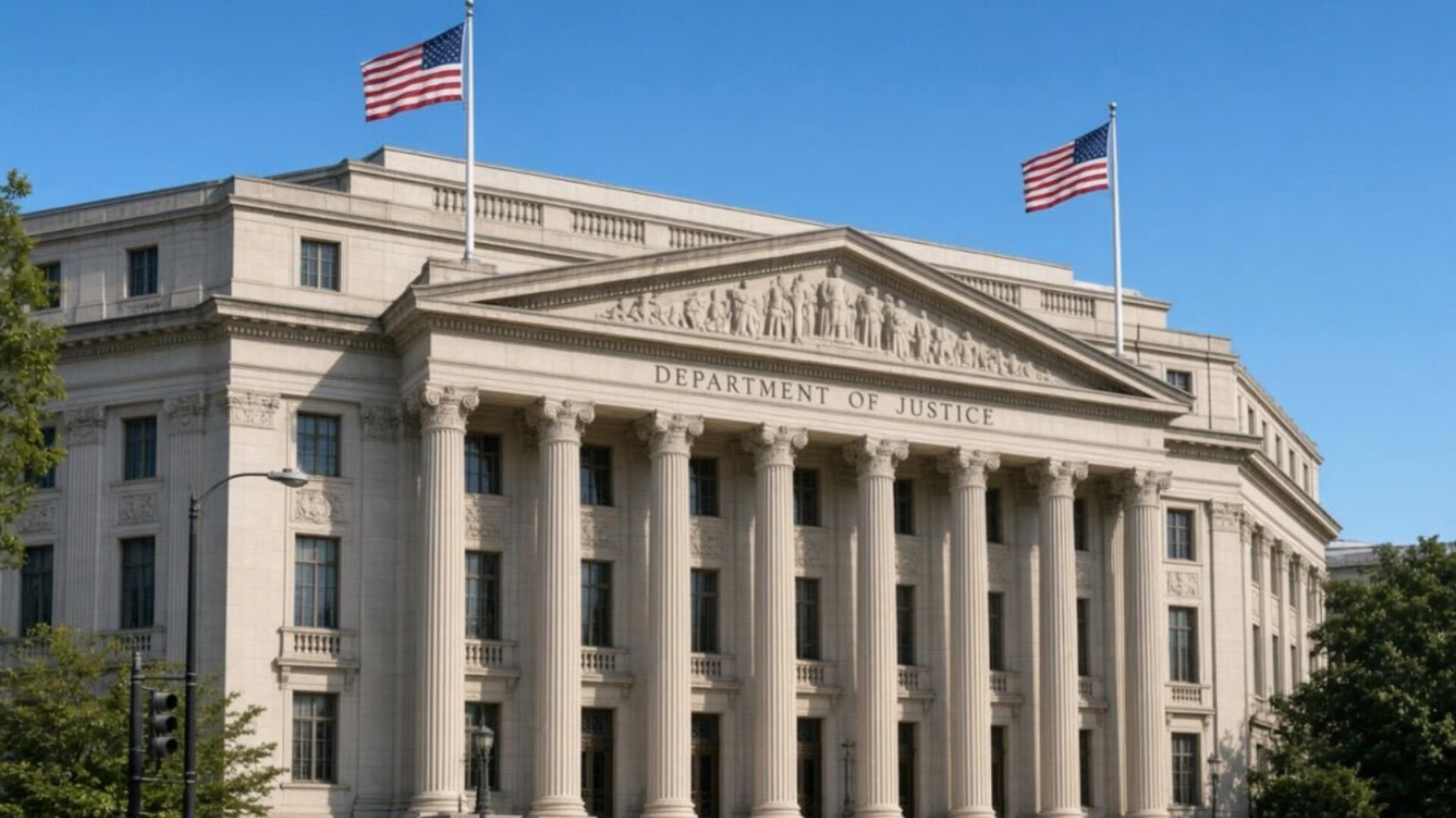
A Justice Department directive dated Oct. 7 and announced Oct. 8 tells federal fraud prosecutors to freeze and seize suspects’ assets before charges are filed, develop cooperating witnesses and argue for tougher sentences. Assistant Attorney General Colin McDonald signed it for the National Fraud Enforcement Division.
What Directive 26-13 Orders
McDonald, who leads the National Fraud Enforcement Division, issued Directive 26-13 to division personnel on Oct. 7, and the Justice Department announced it on Oct. 8. The memo says it builds on an Aug. 13 priorities memo and on Directive 26-12 on corporate enforcement. Its opening line says criminal actors “steal hundreds of billions of dollars from the American people every year.”
The memo says prosecutors should charge the most serious offense likely to produce a sustainable conviction, and it names wire fraud, health care fraud and major fraud against the United States as common charges. It directs prosecutors to ask in every case whether a tax violation occurred and to invite IRS Criminal Investigation to evaluate the tax angle when charges would advance the case.
The division’s Public Trust and Financial Integrity Section will prioritize securities fraud tied to government programs or contracts, schemes aimed at U.S. service members and health care, tax or trade fraud. The memo says the section will use data analytics, supported by the National Fraud Detection Center, to match federal program and contract data against market activity.
The Asset Seizure Toolkit
The most operational part of the memo is a list of six actions to stop schemes while they run. The first is to send restraining orders or seizure letters to freeze assets at banks and cryptocurrency exchanges soon after a theft. The second is to use warrants and civil forfeiture to take accounts, crypto wallets and securities before charges. The third is to seize websites, domains, online accounts, satellite and cellular terminals and related service accounts.
The remaining three are civil. Prosecutors can seek restraining orders against criminal proceeds in banking and health care cases under 18 U.S.C. 1345(a)(2), seek injunctions against government fraud under 1345(a)(1) and use prejudgment remedies such as attachment, garnishment and receivers under 28 U.S.C. 3101 through 3105.
The memo cites 28 C.F.R. 0.70 as the source of the division’s authority. The Justice Department and FBI used a similar approach the same day in seizing Chinese hacking tools and domains rather than waiting for charges. The memo applies that logic to money by taking proceeds first.
Cooperators, Detention and Sentencing
The memo’s second section tells prosecutors to develop cooperators and run undercover operations. It says cooperators must fully accept responsibility, forfeit property tied to their offenses and pay restitution, and it lists what prosecutors will weigh in asking a court for leniency: whether the person disclosed previously unknown crime, advanced the investigation, helped seize proceeds, led to other convictions or disrupted ongoing harm. “Fraudsters willing to cooperate will not get a free pass,” it says.
On detention, the memo tells prosecutors to assess flight risk and danger early and to build a record on the defendant’s means, ties, travel and access to assets. When defendants violate release conditions, the memo says prosecutors should move promptly to modify or revoke release.
The sentencing section sets six principles. “Fraud Division prosecutors must not be mechanical at sentencing,” McDonald said in the memo. The principles call for arguing general deterrence in every case, seeking all supported guideline enhancements, opposing unwarranted reductions and seeking approval for upward variances where the guidelines fall short.
Prosecutors are told to ask for restitution, forfeiture and fines that reflect the full offense, and to consult supervisors about appealing sentences they consider unreasonable. The memo says footnote one creates no enforceable rights for defendants.
What the GAO Estimate Does and Does Not Say
The Justice Department release cites the Government Accountability Office estimate that the federal government loses $233 billion to $521 billion a year to fraud. The GAO report, published April 16, 2024, covers fiscal years 2018 through 2022. GAO said 90% of its estimated losses fell in that range, which equals 3% to 7% of average federal obligations over a period when the government obligated almost $40 trillion.
Dividing by 365 days, a calculation from the GAO range, gives roughly $638 million to $1.43 billion lost a day. The GAO’s own caution applies: “These percentages should not be applied at the agency or program level.” The report also says the estimate is not comparable to improper payment figures, excludes fraud affecting federal revenue and is not a predictive model. The Office of Management and Budget disagreed with the estimate, and GAO maintains it is sound.
How One Minnesota Case Shows the Approach
The department’s Minnesota Medicaid release shows the division’s work. A federal jury in St. Paul convicted Sharmaine Meadows, 45, of Lake Elmo on Oct. 7 on three counts of health care fraud. Each count carries up to 10 years. The department said Meadows billed the now-defunct Housing Stabilization Services program for housing help never delivered and was paid more than $3.6 million from 2020 to 2025.
The program allowed up to 150 billable hours each for transitional and sustaining services per person, which totals 300 hours. Prosecutors said Meadows told employees to bill to the caps regardless of work done, and that the billing implied staff worked more than 20 hours a day for weeks. “The Fraud Division has arrived in Minnesota — and we are here to stay,” McDonald said in the release. Sentencing will occur at a later date before a federal district court judge.