The European Space Agency’s Hera spacecraft imaged the Didymos system on Oct. 18 from 1,280 kilometers away and resolved two asteroids where it had seen one point of light, ESA said. The image is crude, with Dimorphos covering about one pixel, and the pair sits 197 million kilometers from Earth. Hera’s job is to settle what NASA’s 2022 DART impact left unanswered.
What the First Hera Image Shows
Hera took the picture with its monochrome Asteroid Framing Camera, ESA said. Before it, Didymos and its small moon Dimorphos appeared as a single point of light. Earlier in October, two thruster firings one week apart slowed Hera to 20 meters per second relative to the asteroids. DART hit Dimorphos at 6.1 kilometers per second, about 305 times that speed, a calculation from ESA’s two figures. Hera is approaching to look, and DART arrived to collide. Ian Carnelli, ESA’s Hera mission manager, said, “For the very first time we are seeing through Hera’s own eyes” the double asteroid system.
How Big the Didymos Asteroids Are
Dimorphos is 151 meters across, about the size of the Great Pyramid of Giza, and Didymos is 780 meters across, slightly smaller than the Burj Khalifa, ESA said. The smaller body is about 19% of its parent’s diameter, a calculation from the two sizes. The two orbit an average of 1.15 kilometers apart, and Dimorphos moves around Didymos at about 18 centimeters per second.
Those two figures imply an orbit of about 11 hours. A circle with a 1.15-kilometer radius is about 7.2 kilometers around, and at 0.18 meters per second that takes about 40,000 seconds, a calculation from ESA’s two figures that treats the orbit as circular.
What the DART Impact Changed
NASA’s DART spacecraft struck Dimorphos on Sept. 26, 2022, at 6.1 kilometers per second, ESA said. The impact sent debris across 10,000 kilometers of space and shortened Dimorphos’s orbit by about 33 minutes. The orbit change is measured, but ESA lists what it still does not know: whether the impact left a crater, how it reshaped the asteroid and what Dimorphos is made of, how it is built inside and how much it weighs.
What Hera Does Next
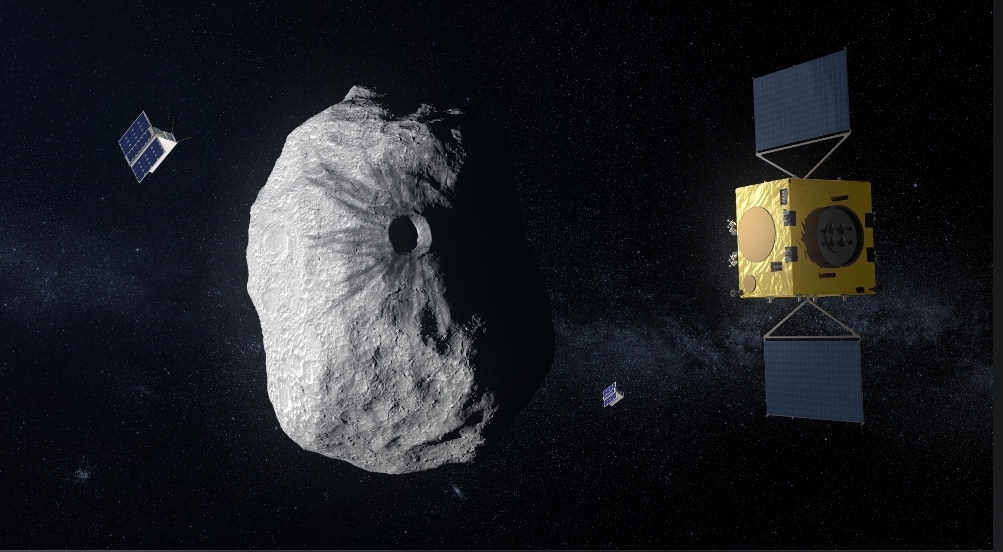
ESA will release the first detailed images of Dimorphos on Nov. 25. Over the coming months Hera will run a close-up “crash site investigation” and release two CubeSats, each about the size of a shoebox, for closer observation. The mission may eventually include landing on Dimorphos. Image: Image from ESA’s Asteroid Framing Camera, from ESA; requires a license or permission from ESA.