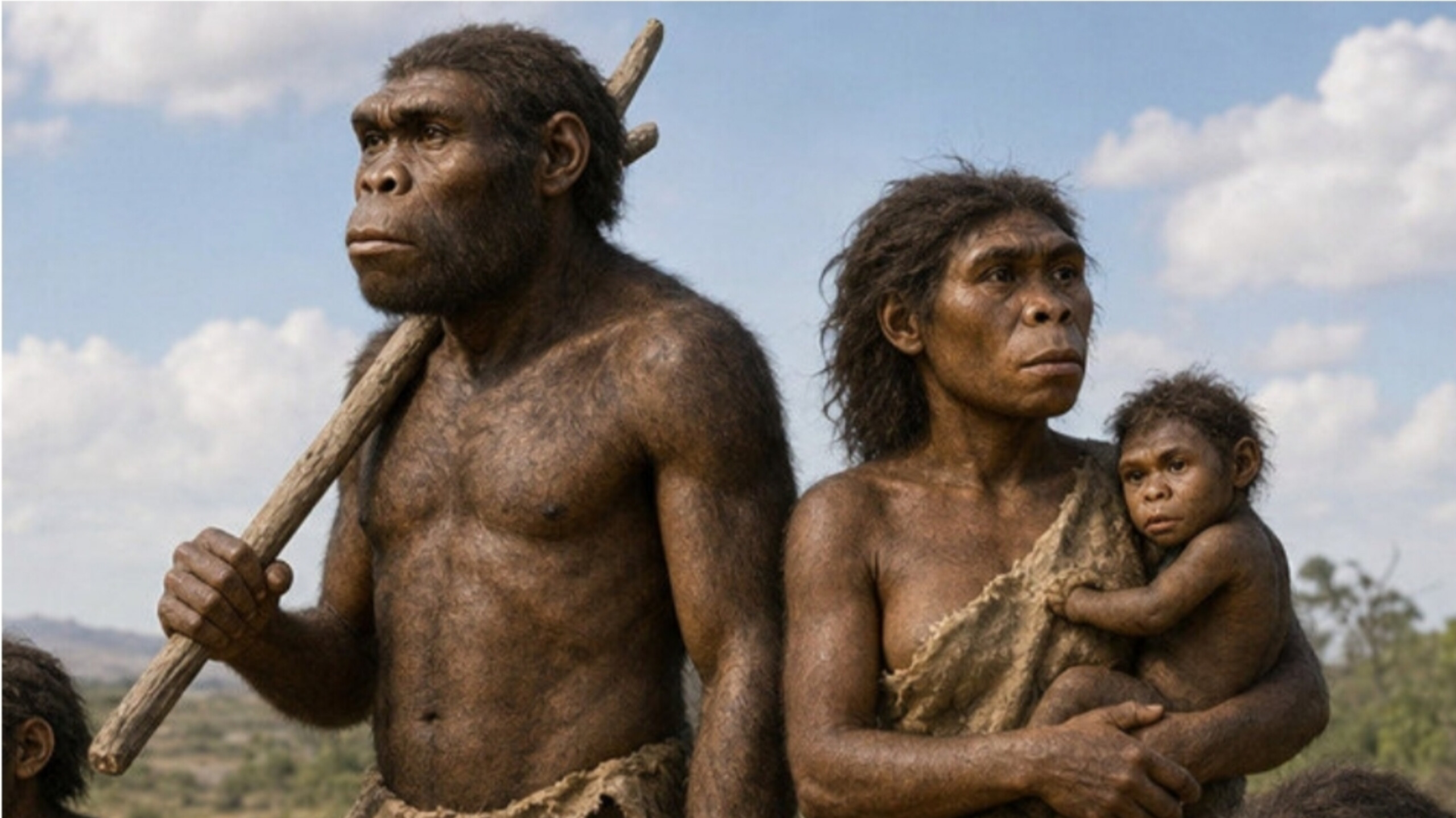
Homo erectus lived in a southern Chinese rainforest until roughly 184,000 years ago, about 200,000 years after scientists thought the species had largely vanished from mainland Asia, according to two papers published in Nature on Nov. 18, the University of Copenhagen said.
The finding breaks one of the tidier ideas in human evolution: that rainforests were a frontier only Homo sapiens could handle. An older human species was living there first, and it was not alone.
What the Homo Erectus Teeth Showed
Researchers studied nine teeth from the Baxian and Naxian caves in Guangxi, about 15 kilometers apart, dated to between 324,000 and 184,000 years ago using five dating techniques, Macquarie University said. Eight belonged to Homo erectus.
The ninth matches none of the expected species. “We can say with a high degree of confidence that the tooth did not belong to Homo erectus,” said Frido Welker, an associate professor at the University of Copenhagen’s Globe Institute and a corresponding author. It may be Denisovan, the team said, but that remains a possibility. “On the Asian mainland, the species was thought to have largely disappeared around 400,000 years ago,” Welker said. A calculation from the two dates: the youngest tooth extends the record by about 216,000 years.
How Proteins Identified the Species
DNA does not survive this long in a hot, wet climate, so the team read proteins preserved in tooth enamel instead. Four teeth carried a single change in the protein ameloblastin that marks them as Homo erectus, the Nature paper reports. None of the 1,461,678 modern people in the gnomAD genetic database carries it. The enamel proteins also gave the sex of five individuals: four males and one female. The caves held more than 18,000 mammal fossils, and the animals placed the people in a rainforest.
Why the Rainforest Finding Matters
“Finding Homo erectus evidence for the first time amongst a rainforest fauna challenges all our assumptions,” said Yingqi Zhang of the Chinese Academy of Sciences. Homo sapiens adapted to rainforests between 100,000 and 13,000 years ago, according to Macquarie. The new dates put Homo erectus there earlier. Researchers who were not involved were persuaded. “The identification looks really solid,”
Richard Potts, director of the Smithsonian’s Human Origins Program, told National Geographic. Ben Marwick, an archaeologist at the University of Washington, said in the same report that “this idea of Homo sapiens exceptionalism may not be the true story.”
Limits of the Study
The evidence is teeth, not skulls. Proteins came out of only five of the nine, and the date ranges are wide. The record also applies to mainland Asia. Homo erectus on the Indonesian island of Java survived later still, to between 117,000 and 108,000 years ago, according to the paper. “This has huge implications for the timeline of Homo erectus,” said Kira Westaway, a geochronologist at Macquarie and a co-lead author. The unidentified ninth tooth is the open question the papers leave behind.