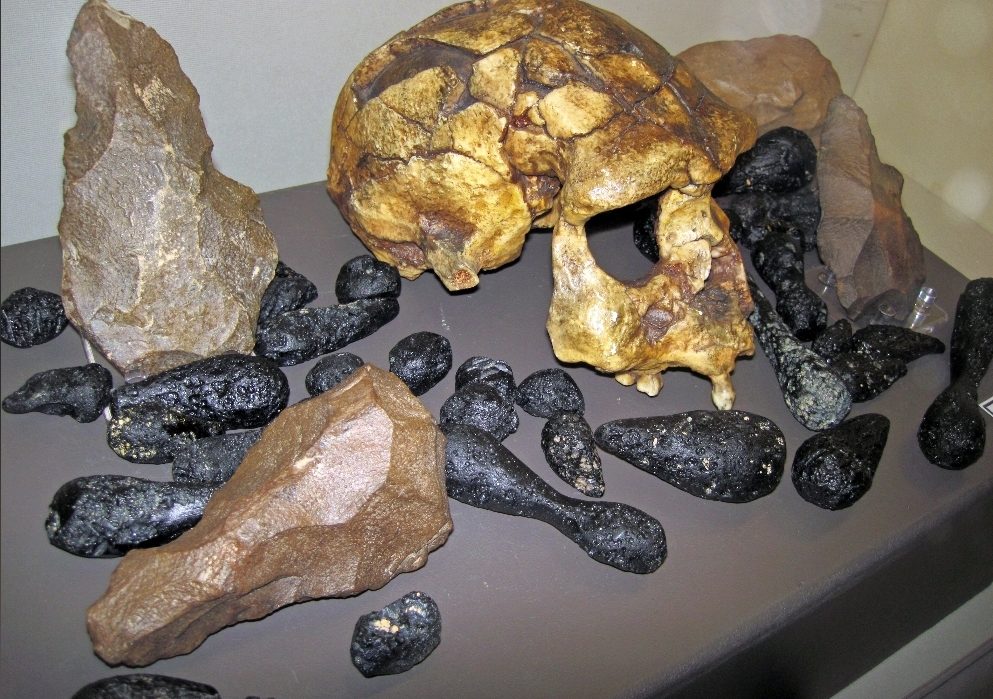
Homo erectus lived in dense tropical rainforest in southern China as recently as 184,000 years ago, a Macquarie University release said Nov. 18, putting an extinct human relative in a habitat scientists had tied only to Homo sapiens.
The finding matters because the rainforest has served as a kind of graduation test in human evolution, with the ability to live there counted as evidence of our own species’ flexibility. Eight teeth from two caves now suggest Homo erectus passed the same test first, and the familiar picture of a grassland and woodland species that ran out of road needs revising.
What the Teeth from Guangxi Show
The study, published in Nature under the title “Rainforest adaptation in late Homo erectus from southern China,” describes eight human teeth and thousands of other fossils from Baxian and Naxian caves in Guangxi province. The two caves sit about 15 kilometers (roughly 9 miles) apart in karst hills, the release said.
Researchers from Macquarie University, Southern Cross University, the Max Planck Institute of Geoanthropology and the Chinese Academy of Sciences dated the remains with five independent techniques. They placed Homo erectus in the caves between 324,000 and 184,000 years ago, which the team called the youngest securely dated Homo erectus evidence in mainland China. The teeth were identified by their shape and by ancient genetic signatures.
Chemistry in the tooth enamel, from both the humans and the animals found with them, pointed to reliance on dense rainforest rather than the open woodland and grassland usually linked to the species. Strontium readings suggested some individuals moved across large forested areas, possibly as far as northern Vietnam. “Finding Homo erectus evidence for the first time amongst a rainforest fauna challenges all our assumptions,” Yingqi Zhang, a paleontologist at the Chinese Academy of Sciences’ Institute of Vertebrate Paleontology and Paleoanthropology, said in the release.
Homo erectus Got There First by the Numbers
The release puts Homo sapiens’ own rainforest adaptation between 100,000 and 13,000 years ago. Set beside the new dates, Homo erectus was living in rainforest at least 84,000 years before the earliest of those dates for our species, and its presence in the Guangxi caves spans a window of 140,000 years (a calculation from the figures in Macquarie’s release).
The release said Homo erectus survived for nearly two million years, far longer than Homo sapiens has existed. The new work adds range to that durability: the species apparently did not need open country to hang on. Kira Westaway, a geochronologist at Macquarie and a co-lead author, said the result has “huge implications for the timeline of Homo erectus as we attempt to understand the causes of its extinction.”
A Busy Year for Homo erectus in China
The rainforest paper is the second Nature study of Chinese Homo erectus this year. In May, a team led by Qiaomei Fu extracted enamel proteins from six Homo erectus individuals from three Chinese sites dated to about 400,000 years ago, according to a Nature press summary. That team proposed that one protein variant reached Denisovans through populations related to those Homo erectus groups, which would mean a sliver of Homo erectus ancestry may have passed into modern humans. Put together, the two studies describe a species that persisted in China later than once accepted and may have left a genetic trace in other human groups.
Limits of the Guangxi Study
The human evidence is eight teeth from one region. The movement toward Vietnam rests on strontium signals the team described as pointing “potentially” in that direction, and the release framed southern China as a likely refuge rather than proof of where the species made its last stand. Why Homo erectus finally disappeared remains an open question.
The best case against reading too much into the find is that one refuge does not define a species: a small population could have survived in a rainforest pocket without the species as a whole being rainforest-adapted. The tooth chemistry showing the humans and animals relied on the same ecosystem is the team’s answer to that, and it is a strong one. Nicolas Bourgon of the Max Planck Institute of Geoanthropology said the animal teeth and the Homo erectus teeth “are telling the same story,” in the release, placing these individuals squarely inside a rainforest ecosystem.