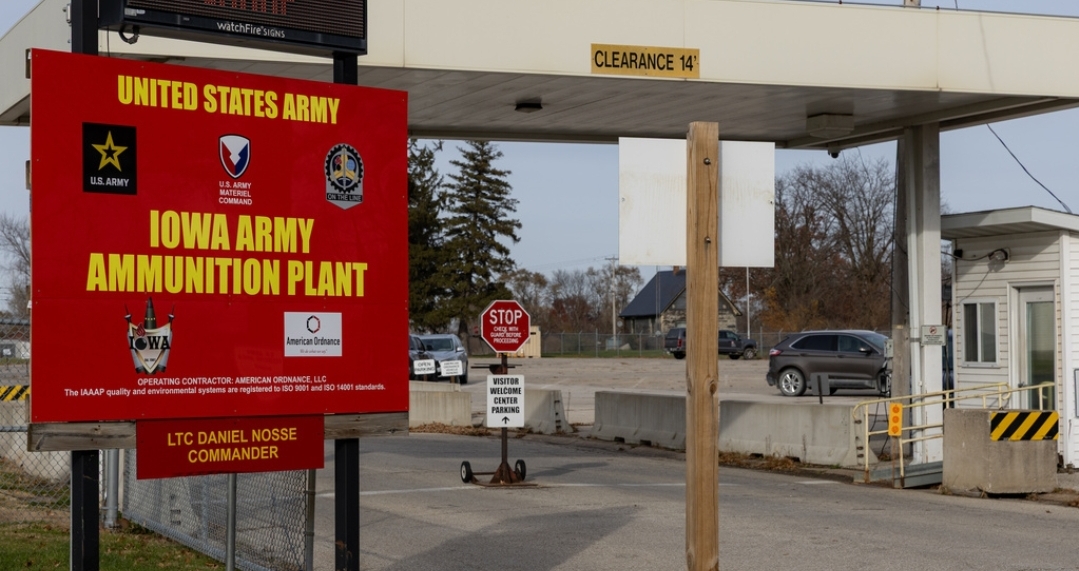
A federal appeals court on Nov. 23 cleared the Army to detonate 68 drums of degraded lead azide at the Iowa Army Ammunition Plant in Middletown, Iowa, ruling that a controlled blast poses less risk than leaving the explosive in place, the 8th Circuit’s opinion shows.
The ruling leaves the people of southeast Iowa with two options, both involving lead. The material sat in storage for more than 20 years until it became too unstable to move, and the court found that the danger of waiting now outweighs the danger of the blast.
What the Eighth Circuit Decided
Judges Bobby E. Shepherd, L. Steven Grasz and Justin D. Smith denied an emergency stay sought by the Iowa Environmental Council and the Sierra Club and lifted the court’s own temporary stay. The case is Iowa Environmental Council v. EPA, No. 26-3374. There was no dissent. The panel wrote that the choice is “not between the risk of a controlled detonation and no explosion at all.” It concluded that “a controlled detonation with attendant safety measures better alleviates the risk of irreparable harm.”
The groups argued that EPA’s emergency permit let the Army detonate lead azide in the open “with less than a week’s notice to the full public.” The court answered that “the 45day notice and comment period is not a prerequisite to issuing an emergency permit.” After the ruling, the groups said, “Detonation, once a last resort, is now the only option remaining.” They added, “Iowans deserve transparency about such a major decision that risks public health and safety,” in a joint statement.
Why the Army Says the Lead Azide Cannot Move
A routine inspection on March 11 found that the stockpile had partly crystallized, making it more sensitive to friction, shock and cold, according to the Army’s public advisory. The 68 drums hold more than 9,700 pounds of net explosive weight, the Army said.
“Inaction is no longer an option,” said Maj. Gen. Eric Shirley, commanding general of Army Sustainment Command. Robert Cekada, director of the Bureau of Alcohol, Tobacco, Firearms and Explosives, said, “It’s just a matter of time when we have an uncontrolled detonation.” EPA issued an emergency hazardous-waste permit on Nov. 13 that expires Feb. 11, 2027, according to the court. The permit requires sampling before and after the blast and cleanup.
How Iowa is Preparing for the Detonation
The Army scheduled the detonation for about 9 a.m. CST Nov. 25, weather permitting. It offered FEMA-supported relocation to residents in a 5-mile cone southwest of the plant plus a 1-mile buffer, with hotels covered through Nov. 27. People outside that zone were told to shelter in place. EPA said it collected more than 1,001 air, land and water samples before the blast and deployed more than 100 staff and contractors, in a Nov. 24 update. The Army said it will clean up any residential property where soil tests above 200 parts per million of lead.
Gov. Kim Reynolds activated the State Emergency Operations Center. “Protecting the health and safety of our people and communities is our highest priority,” Reynolds said in a statement. A calculation from the dates: 259 days passed between the March 11 inspection and the scheduled blast, and EPA issued the permit 12 days before it. A standard permit carries a 45-day public comment period. The emergency route let a permit for an open-air lead detonation reach the public with less notice than a routine one would get. The Army said it will release a final estimate of the affected area after the detonation, and the environmental groups’ challenge to the permit continues in the 8th Circuit.