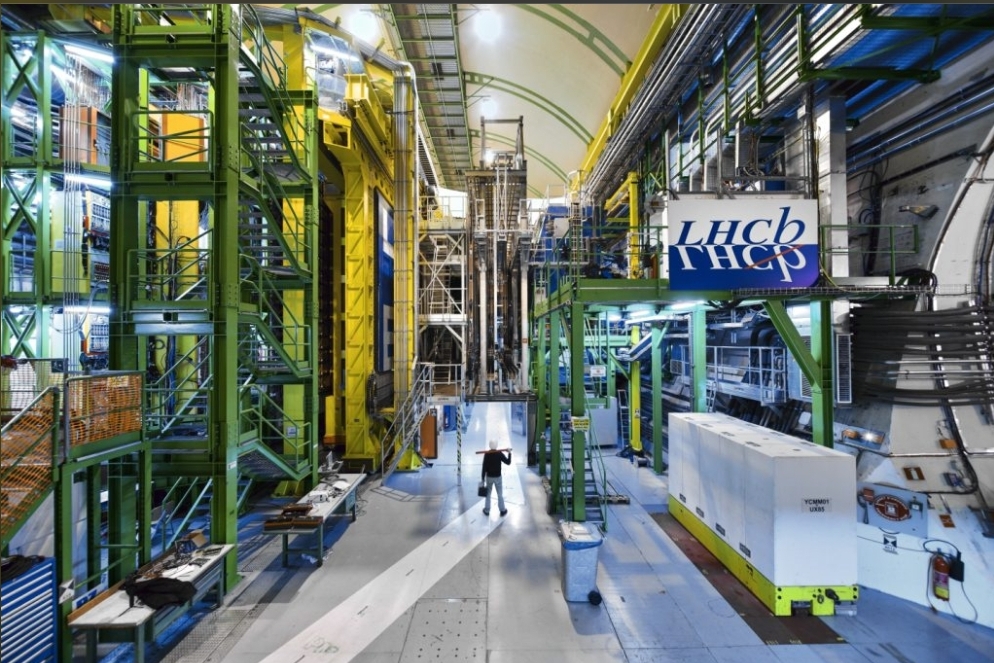
The LHCb collaboration at CERN reported the first evidence from a single experiment for a rare decay of a neutral B meson into two muons, according to a paper posted Oct. 30. The University of Birmingham, a collaboration member, announced the result Nov. 3. The LHCb rare decay is expected to occur only once in every 10 billion such particles, the university said. The result matches the Standard Model of particle physics, so it narrows where new physics could hide and does not point to any.
What the LHCb Paper Measured
The paper reports the first single-experiment evidence for the B0 decay to two muons and the most precise measurements yet of the related Bs decay’s branching fraction and effective lifetime, according to the abstract. The data come from proton collisions at 13.6 teraelectronvolts, recorded with the upgraded LHCb detector in 2024 and 2025. The sample totals 18 inverse femtobarns, a measure of how many collisions the detector recorded. The team combined the new data with results from the Large Hadron Collider’s first two runs to improve precision. The abstract says all the measurements agree with Standard Model expectations.
Why Physicists Study This Decay
A decay that rare is a sensitive test, because an unseen particle or force could change how often it happens. Dr. Niladri Sahoo, a research fellow at the University of Birmingham who convenes the LHCb working group on very rare decays, said the result provides “a powerful new test of the Standard Model” and a window into potential new physics. The word the authors chose is evidence, not observation or discovery. The abstract claims first single-experiment evidence for the B0 decay, which is a lower bar than a discovery claim.
How Much Birmingham Contributed
Prof. Nigel Watson, a professor of particle physics at Birmingham, said the result depends on the commitment of a large international collaboration of scientists and engineers who designed, built and run the experiment. Dr. Dan Johnson, the physics coordinator for the LHCb UK teams, credited UK leadership in the data analysis and in building the silicon detectors the result relied on. The result is a single measurement, and more LHCb data would sharpen it.