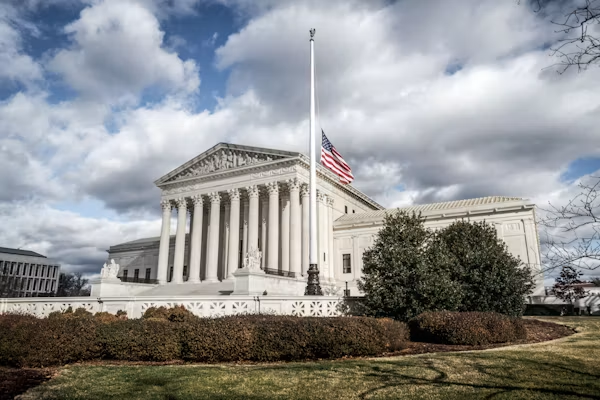
The Supreme Court will decide whether feeding the leaders of a terrorist group counts as “material support” under immigration law. The justices granted review on Oct. 13 in Blanche v. Ozurumba, No. 25-1343, a case about a Nigerian cook who says he worked at a separatist camp against his will.
What the Supreme Court Granted in Blanche v. Ozurumba
The Court’s Oct. 13 order list says simply that the petition for a writ of certiorari is granted. The case is listed in the Supreme Court docket as Todd Blanche, Attorney General, against Izuchukwu Ozurumba. The Justice Department, through Solicitor General D. John Sauer, asked for review. David Meir Zionts of Covington & Burling LLP represents Ozurumba.
The question presented asks whether material support to a terrorist organization bars a person from immigration benefits only when that support advances the organization’s actual commission of terrorism. The government’s case comes from a published decision of the U.S. Court of Appeals for the 4th Circuit, which went against it in September 2025.
The docket shows a slow path to the grant. The Fourth Circuit denied rehearing on Dec. 30, 2025. The government then asked the Court twice for more time, and the justices extended the deadline from March 30 to April 29 and again to May 29. The petition arrived on May 29, 2026. Ozurumba’s lawyers also received an extension, and they filed their opposition on Aug. 3. The government replied on Aug.
18. The Court distributed the petition for its Sept. 28 conference and again for Oct. 9 before granting it on Oct. 13. By calculation from those docket dates, the grant came 137 days after the petition was filed.
How a Nigerian Cook Became a Material Support Case
The Fourth Circuit opinion lays out the facts. Ozurumba lived in Venezuela from 2005 to 2010, returned to Nigeria and struggled financially. In 2022 an acquaintance pointed him to a cooking job. Armed security guarded the rural camp where he was taken. He later learned it belonged to a group called the Unknown Gunmen, which the Nigerian government considers a terrorist organization.
He cooked three meals a day for 15 to 17 camp leaders. The opinion says he learned of the group’s violence, withdrew from social life and refused to join a raid. His pay stopped for a period, and guards prevented him from leaving. After about six months he escaped. He says he was then threatened and attacked in Lagos, so he fled to Venezuela and reached the U.S. southern border in July 2023.
The Department of Homeland Security issued a notice to appear in August 2023. An immigration judge ruled on March 7, 2024 that the Unknown Gunmen qualify as a Tier III terrorist organization and that Ozurumba’s cooking was material support. That finding barred asylum and withholding of removal. The judge also denied deferral under the Convention Against Torture and ordered him removed.
The Board of Immigration Appeals affirmed on Sept. 27, 2024. The Board held that the material-support bar has no exception for minimal support or for duress, so even small contributions can trigger it. According to the opinion, his attorneys say he was removed to Nigeria on April 1, 2025, before the Fourth Circuit ruled.
What the Statute Says About Material Support
The bar sits in 8 U.S.C. 1182(a)(3)(B). Subclause (iv)(VI) covers acts that the actor knows, or reasonably should know, afford material support. It lists examples: a safe house, transportation, communications, funds, false documents, weapons, explosives and training. The support must go either to the commission of a terrorist activity or to an individual the actor knows, or reasonably should know, has committed or plans to commit one.
Congress did not define “material support.” Food does not appear on the list. The statute also reaches beyond groups the State Department has designated. Tier III organizations, the label the immigration judge used, include any group of two or more people that engages in, or has a subgroup that engages in, the listed activities, whether organized or not.
The Fourth Circuit said that the bar blocks asylum and withholding of removal, though deferral under the Convention Against Torture stays available.
Why the Fourth Circuit Reversed the Board
Judge James Wynn wrote for the majority, joined by Judge Berner. The court read “material” to mean both relevant and significant, and it drew on the statute’s list of examples, each of which can be used for terrorism or readily diverted to it. Relying on the Supreme Court’s decision in Holder v. Humanitarian Law Project and its own earlier decision in Viegas v. Holder, the majority adopted a test: support must be sufficiently substantial “standing alone to help the terrorist organization accomplish its terrorist activities.”
The court rejected the Board’s Matter of A-C-M- standard, which reached support with even a de minimis tendency to sustain a group. It said the Supreme Court’s decision in Loper Bright ended the deference courts once gave agencies on such questions. The majority concluded that Ozurumba’s cooking may have sustained the group in a broad sense but did not help it carry out terrorism. It described him as a captive laborer whose work “had nothing to do with those activities.” The court vacated the Board’s order and sent the case back.
The majority declined to decide whether the bar contains a duress exception. It questioned whether the circuit’s earlier decision in Barahona v. Holder, which deferred to the Board on that point, still binds after Loper Bright, and it said a split exists among circuits. It left that issue for another case. It also did not order the government to return Ozurumba, leaving that to the agency.
What Judge Richardson Argued in Dissent
Judge Richardson would have affirmed the Board. His dissent opens with the line that an army marches on its stomach, and it argues that food is support within the plain meaning of the statute.
He reads the phrase “to a terrorist organization” to reach support that is not tied to specific terrorist acts, and he points to the statute’s separate clauses and to Humanitarian Law Project. He finds material support in both quantity and quality. The dissent counts about 8,000 meals served over months and says they met the basic needs of the group’s leaders.
He argues the majority’s test would make the statute’s list of objects superfluous and misreads Humanitarian Law Project. In a footnote, he says that if Barahona no longer binds, he would reject a duress exception on the merits.
The Meal Count and What It Leaves Open
The dissent’s figure of 8,000 meals can be checked against the facts in the majority opinion. This is a calculation, not a court finding. Three meals a day for about six months, or roughly 180 days, comes to 540 meals prepared. Each was served to 15 to 17 leaders, which yields about 8,100 to 9,200 plates. The arithmetic lands near the dissent’s number, and it shows why the two judges could look at one record and disagree. Both agree on the volume of food. They disagree on whether volume matters when none of the food was a weapon, a fund or a safe house.
The question the Court agreed to answer is narrower than the facts of one cook’s story. If the justices adopt the Fourth Circuit’s test, the government would have to show that a contribution helped a group commit terrorism before the bar applies. If they side with the dissent, the bar could reach routine goods and services supplied to a group’s members, including by people under pressure, subject to whatever the Court says about duress.
Ozurumba is no longer in the United States, according to his attorneys, and the Fourth Circuit left his return to the agency. The justices’ ruling will set the standard immigration judges apply to every case in which a person’s contact with an armed group involved something other than guns or money.