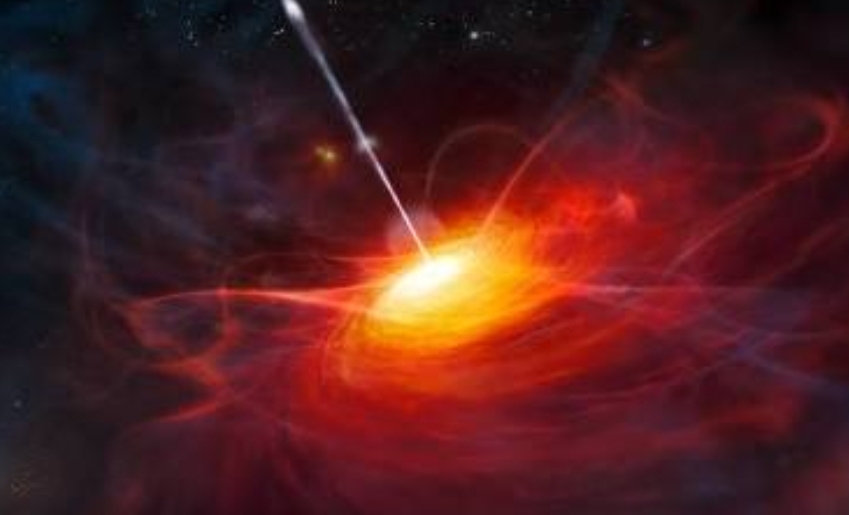
The European Space Agency’s Euclid telescope has found the most distant quasar ever seen, a blazing black hole that existed about 630 million years after the Big Bang and weighs about 360 million times the mass of the sun, ESA said on Nov. 24. The object is a problem for the textbooks. A black hole that heavy, that early, had to grow faster than astronomers’ standard models comfortably allow, and Euclid keeps finding more of them.
How Euclid Found the Most Distant Quasar
The quasar’s formal name is J1504+6252. The team nicknamed it Dún Aonghasa, after a prehistoric cliff-top fort on the Irish island of Inis Mór, according to the Max Planck Institute for Astronomy, which led the work. Euclid picked it out among millions of objects in about 18 months of survey data.
Telescopes including Keck, the Large Binocular Telescope, Hubble and the James Webb Space Telescope confirmed it, and Webb measured the black hole’s mass. The findings appear in Astronomy & Astrophysics. It sits at a redshift of 8.13, the first quasar ever found beyond redshift 8, and it beats Euclid’s own previous record by about 40 million years, ESA said. A quasar is a supermassive black hole pulling in gas so fast that the material glows, often outshining its entire host galaxy by hundreds to thousands of times.
Why the Quasar Breaks the Rules
Black holes grow by swallowing matter, and there is a practical limit on how fast they can do it. Dún Aonghasa is feeding slowly now, ESA said, so it must have grown in very fast bursts even earlier. “The closer to the Big Bang we find them, the faster their black holes must have grown,” said Julien Wolf, the lead author, a postdoctoral researcher at the Max Planck Institute for Astronomy who is now at the European Southern Observatory.
The institute said the growth rate fits a “direct-collapse” origin, in which a huge gas cloud collapses straight into a black hole instead of starting as the remains of a single star. If astronomers find even more distant quasars, black holes formed in the first instants after the Big Bang would become a more likely explanation.
How Fast Euclid is Finding Ancient Quasars
ESA said Euclid has announced 31 ancient quasars in about a year and a half, 12 of them beyond redshift 7. Earlier surveys took about 15 years to find that many that distant. A calculation from those figures: Euclid is finding them roughly 10 times faster. The quasar is seen as it was about 13.1 billion years ago, when the universe was about 5% of its current age. A calculation for scale: in an 80-year human life, that is a child not yet 4 years old, already carrying a black hole of 360 million suns.
Few of these objects exist to be found. ESA said only a few tens of quasars at redshift 8 are expected across Euclid’s entire survey, which means each new one tests the theories again. Euclid’s survey of the sky continues, and the team expects to search its upcoming data releases for quasars even more distant.