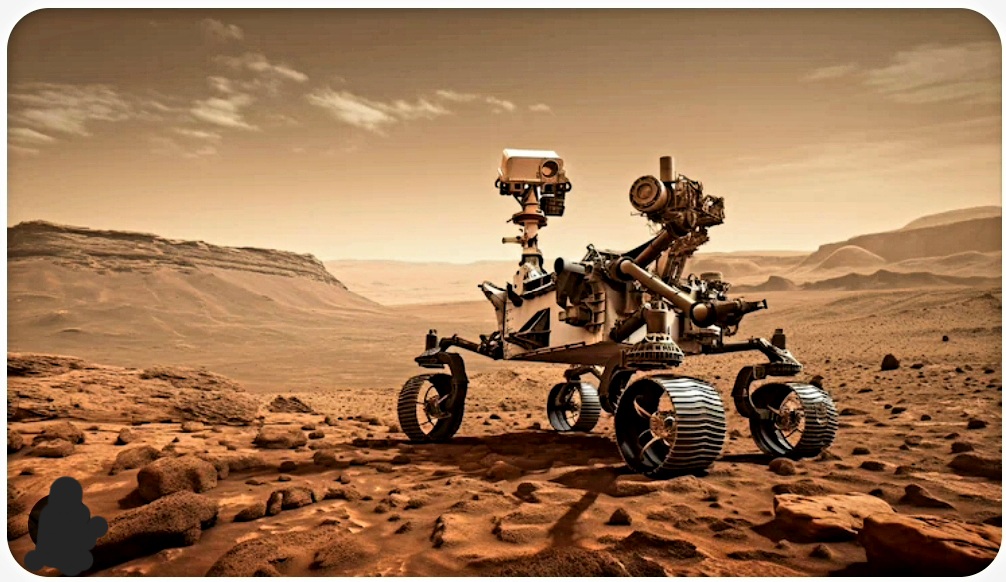
NASA’s Perseverance rover set a new off-world driving record on Oct. 11, when its odometer reached 28.10 miles (45.22 kilometers). That passed the 28.06 miles (45.16 kilometers) driven by Opportunity, the rover that explored Mars from 2004 to 2018, NASA said.
How Close the Record was
The margin is small. Perseverance beat Opportunity by 0.04 miles by NASA’s rounded figures, or 0.06 kilometers, about 60 meters (a calculation from the posted numbers). A navigation camera photograph from Oct. 11 shows a drive of 299.6 feet (91.31 meters) that carried the rover past the old mark. The rover was on its 2,006th Martian day, called a sol, and was heading toward a site called Idubi.
Perseverance reached the record much sooner than Opportunity did. NASA said the newer rover covered in about five and a half years a distance that took Opportunity almost 15 years. Opportunity worked for 5,111 sols. Perseverance reached the same mileage in 2,006 sols, or about 39% of that time.
Dividing distance by sols gives an average of about 74 feet per sol for Perseverance and about 29 feet per sol for Opportunity. Those averages are calculations from NASA’s mileage and sol counts, and they include days the rovers did not drive. By that measure Perseverance moved about 2.5 times as far each sol.
The Lunar Records It Also Passed
NASA’s account puts the Mars record in a longer line of distance marks. Apollo 17 astronauts drove 22.2 miles (35.7 kilometers) on the Moon in 1972. The Soviet Lunokhod 2 rover covered 24.2 miles (39 kilometers) in 1973. Perseverance has passed both, NASA said.
NASA’s own Curiosity rover, which landed in Gale Crater in 2012, has logged more than 23.65 miles (38.07 kilometers). That puts Perseverance about 4.45 miles ahead of it, a subtraction from NASA’s figures. Spirit, Opportunity’s twin, drove 4.8 miles (7.7 kilometers) before the Martian winter ended its mission in 2010. The first Mars rover, Sojourner, traveled about 330 feet (100 meters) over 83 sols in 1997.
Why the Rover Drives Itself
The record owes a lot to autonomy. NASA said Perseverance has driven more than 90% of its total distance using AutoNav, its self-driving system. Opportunity and Spirit used a first-generation system for about 5% of their distance. At 90%, AutoNav accounts for at least 25.3 miles of the 28.10 total, a calculation from NASA’s percentage. Five percent of Opportunity’s 28.06 miles would be about 1.4 miles.
NASA describes the process as thinking while driving. The rover photographs terrain as it moves, builds a three-dimensional hazard map and plans its path between waypoints that planners on Earth set. It can cover as much as 1,351 feet (412 meters) in one sol. The Oct. 11 record drive was 299.6 feet, about 22% of that daily maximum.
The processing power has grown with each generation. Sojourner used 20 measurement points to judge the path ahead, NASA said. Perseverance processes 600,000 points each time it looks. That is 30,000 times as many points, a calculation from the two numbers. Mark Maimone, deputy team chief for robotic operations, said in NASA’s account that the rover is a better driver than the one that landed.
He said newer software lets it steer less and roll more, and lets it check its position against orbital maps in the middle of a drive. Glare in the navigation cameras when the rover drives toward the Sun is why the team parks it by mid-afternoon, NASA said.
What Opportunity Left behind
Opportunity completed the first extraterrestrial marathon in 2015, NASA said. A marathon is 26.2 miles, so Perseverance’s 28.10 miles equals about 1.07 marathons, a calculation from NASA’s odometer reading. Opportunity’s own total of 28.06 miles is about 1.07 marathons as well, which shows how narrow the margin is.
Opportunity worked for 5,111 sols. Perseverance has used 2,006 sols so far, and NASA has now approved it to keep working into 2028. If Perseverance matched Opportunity’s 5,111 sols and kept its current average of about 74 feet per sol, it would reach roughly 71.6 miles. That projection is a rough calculation from NASA’s figures, not a NASA forecast, and it assumes the same pace, which terrain and mission plans may change.
Far past the Original Plan
Steven Lee, project manager for the Curiosity and Perseverance rovers at NASA’s Jet Propulsion Laboratory, said in NASA’s account, “The original mission called for no more than 12.4 miles of driving.” He said the team expects the rover to keep adding to the record for years.
Against that 12.4-mile plan, 28.10 miles is 2.27 times the distance, or 15.7 miles more, calculated from NASA’s figures. NASA said it recently approved the mission’s first extension, which began in October and runs through roughly the end of 2028.
Where Perseverance Heads Next
The rover is driving toward Idubi, a site in the Lac de Charmes region off the western rim of Jezero Crater. NASA said Lac de Charmes holds some of the oldest terrain the rover has explored. Scientists hope Idubi will show traces of ancient hydrothermal systems, which are hot-water environments.
After Lac de Charmes, the rover will follow the crater rim south toward Rainbow Falls, a block of ancient crust about 328 feet (100 meters) wide that the Jezero impact pushed upward. NASA gave no arrival date for Idubi or Rainbow Falls.
Perseverance has collected 29 rock and regolith samples so far. NASA said the rover earlier found a potential biosignature at a rock called Cheyava Falls. NASA’s account describes it as potential, not confirmed.