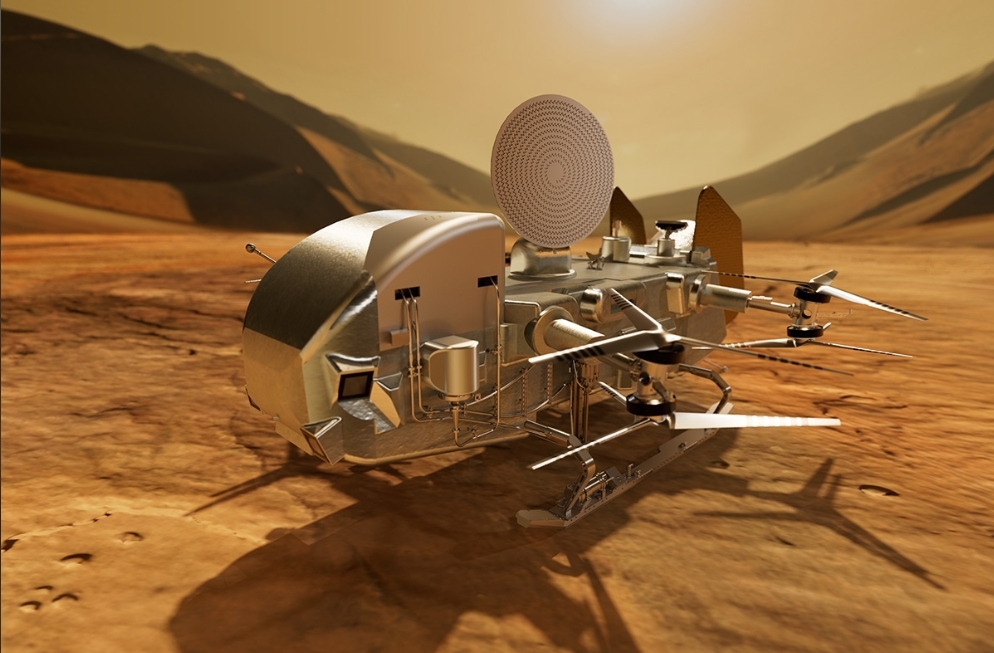
NASA will carry names to Saturn’s moon Titan aboard Dragonfly, a rotorcraft that will fly across the surface, and anyone who wants to send their name to Titan must submit it by 11:59 p.m. EST on Jan. 15, 2027, NASA said.
Dragonfly is the first rotorcraft science mission, and the trip is long. It launches in 2028 and arrives in 2034, about six years in transit, a calculation from NASA’s two dates. The name list closes 73 days after Nov. 3, also a calculation from the dates.
How the Dragonfly Name Campaign Works
NASA will place the selected names on a microchip aboard the rotorcraft, and each person whose name is selected receives a personalized digital boarding pass. Nicky Fox, NASA’s associate administrator for the Science Mission Directorate, said, “NASA’s Dragonfly mission will simply blow your mind.” She called it the first-ever rotorcraft science mission and said NASA will use it to explore Titan.
What Dragonfly Will Do on Titan
Dragonfly will fly between locations on Titan to search for prebiotic chemistry, the chemistry that came before biology. Titan has a thick atmosphere, lakes and rivers of liquid methane and sand dunes, NASA said. NASA’s mission page says Dragonfly will explore areas including the dunes and Selk Crater. Each flight covers several miles. The planned mission lasts 3.3 years, with about one flight every one to two Titan days, which are roughly 16 Earth days each.
A suite of scientific instruments inside the rotorcraft analyzes the surface samples it collects. At that pace Dragonfly flies about once every 16 to 32 Earth days, a calculation from NASA’s figures. The spacecraft spends six years traveling to Titan for a flight schedule measured in weeks.
Who is Building and Managing Dragonfly
The Johns Hopkins Applied Physics Laboratory in Laurel, Maryland, builds the rotorcraft and leads the mission, with Elizabeth Turtle as principal investigator. NASA selected Dragonfly in 2019 as the fourth mission in its New Frontiers Program, which NASA’s Marshall Space Flight Center in Huntsville, Alabama, manages for the Science Mission Directorate. From selection in 2019 to arrival in 2034 is 15 years, a calculation from NASA’s dates. The name deadline is Jan. 15, 2027.