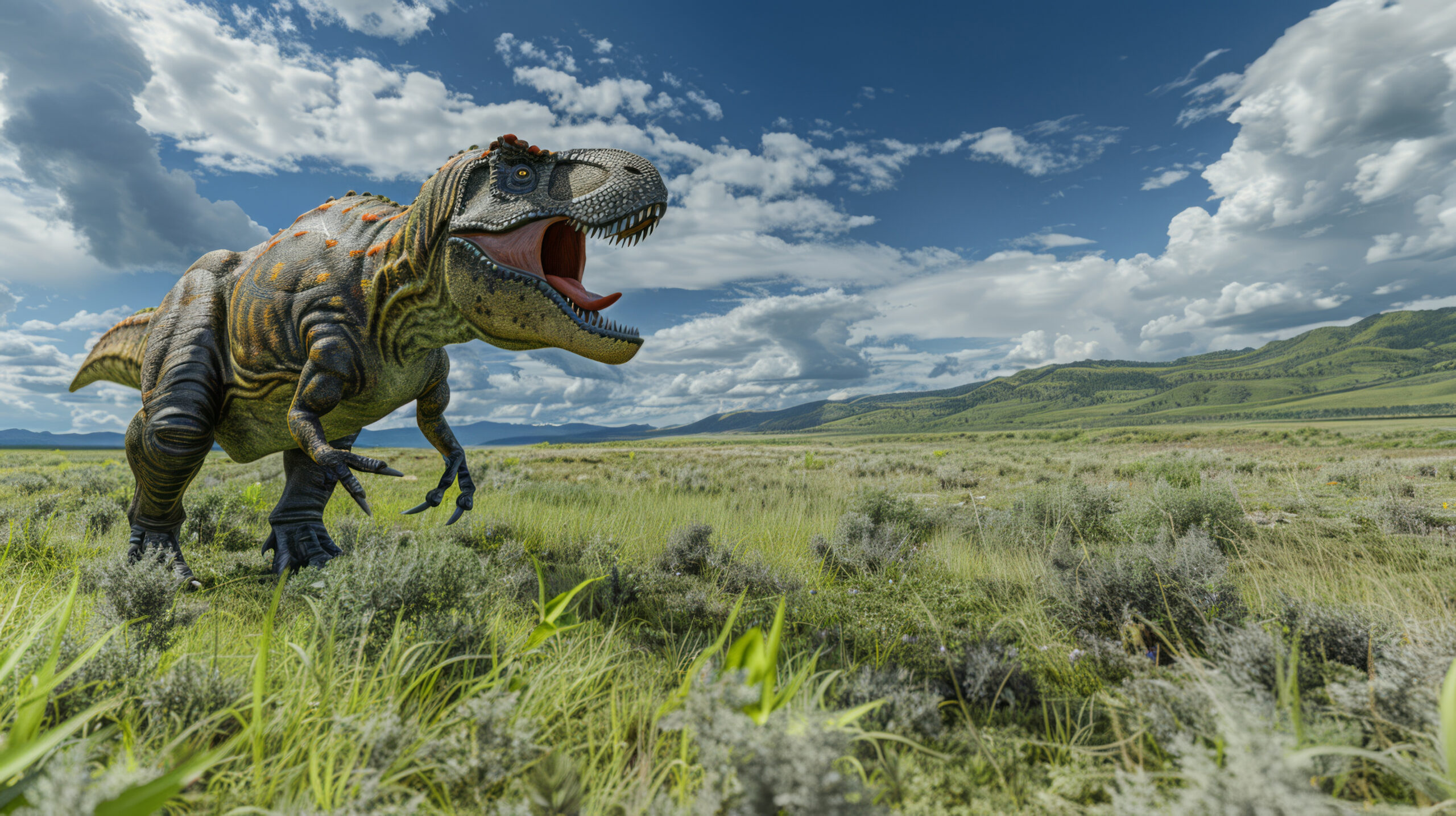
Kent M. Hups, a science teacher at Northglenn High School in Colorado, found the first-ever documented trackway of an adult Tyrannosaurus rex in 2025 on U.S. Forest Service land near Marmarth, North Dakota. A study describing the discovery published Sept. 8, 2026, in the Journal of Vertebrate Paleontology.
Colorado Teacher Finds T. Rex Footprints in North Dakota
Hups, an amateur fossil hunter outside the classroom, spotted the tracks in the Hell Creek Formation, a fossil-rich rock layer that spans parts of Montana, North Dakota, South Dakota and Wyoming. The formation preserves sediment laid down about 66.5 million years ago, in the final stretch of time before the asteroid impact that ended the age of dinosaurs.
Hups said the find grew out of habits he tries to instill in his students. “As a teacher, I’m always telling my students that science starts with curiosity, passion and careful observation. I never imagined that could lead me to a discovery like this,” Hups told ABC News.
Hups described the moment he realized what he had found. “I immediately started jumping up and down and hooting and hollering,” he said. The discovery stuck with him well past that afternoon in the field. “It was like a real pivotal moment. I didn’t sleep very much that night,” Hups said, according to the same ABC News report.
First Adult T. Rex Trackway Documented by Scientists
Isolated T. rex footprints have turned up before, and bones from the species are relatively well known among large carnivorous dinosaurs. A trackway is different: a connected sequence of footprints left by a single animal in motion, rather than a single print or a skeleton frozen in place. Until Hups’ discovery, no trackway from an adult T. rex had been formally documented.
The trackway Hups found stretches 23 feet and contains four footprints, alternating two left and two right, with a stride of 13 feet between them. Each print measures about 3 feet long. A research team that includes Tyler Lyson of the Denver Museum of Nature & Science and Peter Falkingham of Liverpool John Moores University authored the study confirming the find.
Lyson, senior curator of vertebrate paleontology at the Denver Museum of Nature & Science, said the tracks add something bones alone cannot provide. “Bones tell us an enormous amount about these animals, but footprints capture a moment of behavior. With a trackway, we can actually follow an animal as it moved across the landscape. That is incredibly rare for T. rex,” Lyson said in a statement from the Denver Museum of Nature & Science.
Falkingham, a professor of palaeobiology at Liverpool John Moores University, pointed to the digital tools that let researchers analyze the prints in detail. “The technology we’re able to apply in the digital age means my colleagues could scan [the tracks],” Falkingham told ABC News.
T. Rex Walking Speed Nearly Matches Human Pace
Using the stride length and print spacing, researchers calculated the animal’s walking speed at 3.5 to 4.5 mph. An average adult human walking pace is commonly cited at around 3 to 4 mph, putting the T. rex’s documented gait in roughly the same range as a person on a casual walk.
The comparison cuts against the image of T. rex most familiar from film and popular culture, where the animal is typically shown charging or sprinting. This trackway does not speak to that version of the dinosaur at all. A trackway can only record the specific gait an animal was using at the moment its feet touched that ground, so the 3.5 to 4.5 mph figure describes one walking dinosaur on one occasion, not a ceiling on how fast T. rex could move.
The animal’s top running speed remains a separate and long-debated question among paleontologists, one this particular set of footprints was not built to answer.
What the tracks do establish is more specific and, researchers say, more useful: a multi-ton predator with a body length that could reach roughly 40 feet was, in this instance, moving at essentially the same pace a person could match on foot without breaking into a jog. The stride length of 13 feet reflects the animal’s long legs and hips rather than exertion, since a slow, evenly spaced walking gait can still cover ground quickly when each leg is that long.
Hell Creek Formation Tracks Date to Final Days of the Dinosaurs
The tracks date to about 66.5 million years old, placing them in the geologic window immediately preceding the mass extinction event linked to an asteroid impact. That timing means the animal that left these footprints was walking across the landscape near the very end of the period when non-avian dinosaurs existed on Earth.
Researchers say the discovery underscores why footprint evidence carries a different kind of value than bones. A skeleton can describe an animal’s anatomy long after death, while a trackway is a direct record of a living T. rex crossing real ground, captured in a single, ordinary moment 66.5 million years ago.
What Happens Next
Researchers plan to plaster-jacket three of the four footprints and airlift them by helicopter in fall 2026 to the Denver Museum of Nature & Science, where staff will prepare them for preservation and eventual public display. Researchers are also building high-resolution 3D digital models of the tracks to support further analysis of the animal’s gait.
Those digital models are expected to let scientists study the trackway in more detail than fieldwork alone allows, refining estimates of speed, stride mechanics and body movement without further disturbing the original prints. For Hups, the discovery has already changed how he talks to his students about where careful observation in the field can lead.