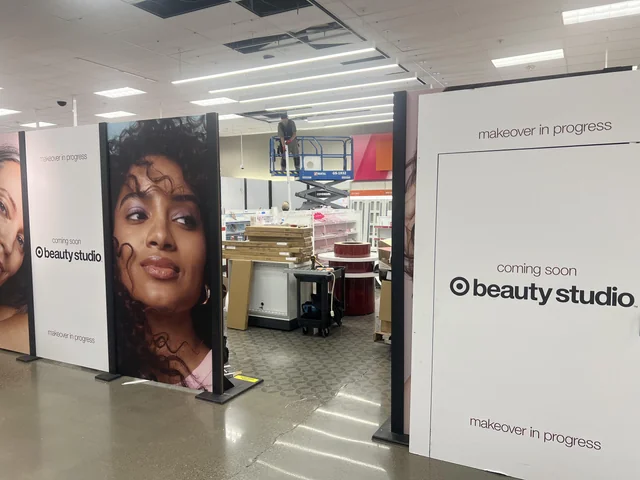
Target launched its new beauty concept, Target Beauty Studio, on Sept. 10 across more than 600 stores, featuring 90 brands and more than 1,600 products. Only two of those 90 brands, Briogeo and Glamazon Beauty, are Black-owned.
Target Beauty Studio Replaces Ulta Shop-In-Shops
Target Beauty Studio replaces the retailer’s earlier Ulta Beauty shop-in-shop format, which had operated inside Target stores as a joint venture between the two companies. The new concept rolled out in-store and online on Sept. 10, giving Target its own branded beauty footprint across more than 600 locations nationwide.
The lineup spans 90 brands and more than 1,600 products, according to figures Target has provided. Amanda Nusz, senior vice president of merchandising at Target, said the company built the assortment around what customers told it they wanted from the retailer’s next phase in beauty. “A lot of time and energy has been spent with the consumer working on what we believe is going to make us compelling in our next chapter of beauty,” Nusz told Modern Retail.
Target has said nearly 40% of the 90 brands in Beauty Studio were founded by people the company describes as “diverse” founders. Target has not publicly defined what qualifies a founder as diverse under that figure.
Briogeo and Glamazon Beauty Are the Only Black-Owned Brands
Of the 90 brands in Target Beauty Studio, two are Black-owned: Briogeo, a haircare brand founded by Nancy Twine, and Glamazon Beauty, a cosmetics brand founded by Kim Baker.
Baker described the partnership in positive terms. “Target has been a dream retailer for me for many years, and from the beginning of our partnership, I’ve felt seen, heard and supported,” Baker told Modern Retail.
Target has said it has invested $2 billion total in Black-owned businesses and has doubled its Black-owned brand partnerships since 2020. Those figures come from the company itself and have not been independently verified.
The Gap Between Target’s 40% Figure and Its Black-Owned Brand Count
Two Black-owned brands out of 90 total brands works out to 2.2%. That figure sits alongside Target’s own claim that nearly 40% of the 90 brands come from “diverse” founders, a gap of roughly 38 percentage points between the headline diversity number Target has promoted and the actual count of Black-owned brands in the assortment.
The gap traces back to how Target defines its terms. “Diverse founders” is a broad category that includes founders from a range of racial, ethnic, gender, and other backgrounds, rather than referring specifically to Black-owned businesses.
Target has not defined publicly, and it can include founders who are not Black. That means the 40% figure, as stated, does not describe Black-owned representation specifically. The 2.2% figure, by contrast, is a direct count: two Black-owned brands among 90 total.
Marketing consultant Lola Bakare said the low count falls short given Target’s stated ambitions and past positioning. “I think the average consumer might be glad there are two, but what we also know is that they can do so much better,” Bakare told Modern Retail.
Criticism Lands Amid Target’s Broader DEI Pullback
The Beauty Studio launch comes roughly a year after Target ended its formal diversity, equity and inclusion initiatives and renamed its “supplier diversity” team to “supplier engagement.” It also follows a separate, more recent controversy over the retailer’s Halloween costume selections.
DEI consultant Christy Pruitt-Haynes said the makeup of the Beauty Studio brand list reflects who was involved in building it. “When you don’t have diverse voices and diverse life experiences in a room, people don’t see problems,” Pruitt-Haynes told Modern Retail.
Target has framed the Beauty Studio launch as a business decision rather than a diversity decision. In a statement, a Target spokesperson said the new concept is meant to sharpen the retailer’s focus on categories where it can compete most effectively. “Getting back to growth starts with investing in the categories and experiences where Target is uniquely positioned to win, all through our distinctive combination of style, design and value,” a Target spokesperson said, according to Modern Retail. TheGrio also reported on the launch and the criticism it drew.
The timing matters for a category where shade range and hair texture formulation directly affect whether Black consumers can find products that work for them. Beauty is one of the retail categories where brand representation has a functional as well as symbolic dimension, since a lineup with few Black-owned brands can also mean fewer products developed specifically for a range of skin tones and hair types.
Target’s decision to replace its Ulta Beauty shop-in-shop format with an in-house concept also changes who controls the brand-selection process going forward. Under the joint venture, Ulta Beauty had a role in curating which brands appeared inside Target stores; under Target Beauty Studio, Target itself controls the full assortment, meaning the 90-brand, two-Black-ownedbrand lineup reflects Target’s own merchandising choices rather than a format it was sharing with an outside beauty retailer.
What Happens Next
Target has not announced a timeline for whether it will expand the brand roster inside Beauty Studio. The company has not said whether it plans to add more Black-owned brands to the assortment or revisit how it defines “diverse founders” in future disclosures about the concept. For now, Briogeo and Glamazon Beauty remain the only two Black-owned brands among the 90 featured in the new format, and Target has pointed to its broader $2 billion claimed investment in Black-owned businesses as evidence of its commitment beyond the shelf count in any single retail concept.