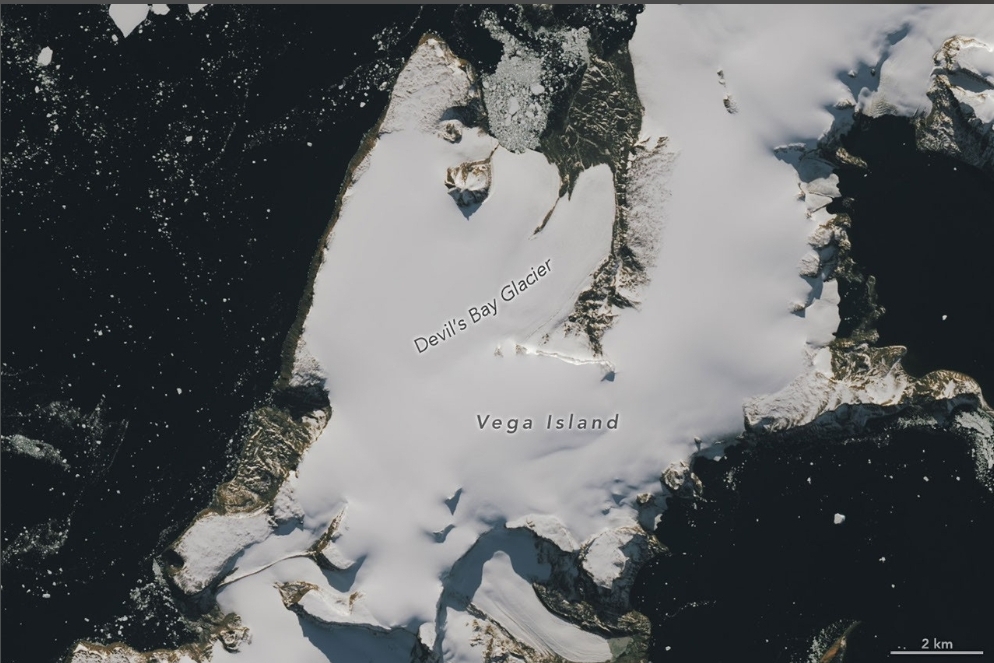
A skull-shaped landform on Vega Island in Antarctica became visible in NASA satellite images taken Oct. 10, after a warm winter cleared snow that covered it in March 2025, according to the NASA Earth Observatory. The agency posted the images Oct. 30. The skull is a rock peak, a debris ridge and a glacier, arranged so that a snowless view reads as a face, and the image works as a record of how much snow the island lost in 19 months.
What Makes Up the Skull
Vega Island sits in the Weddell Sea, east of the Antarctic Peninsula. NASA says a rocky peak called a nunatak forms the eye socket, a lateral moraine forms the mouth and Devil’s Bay Glacier forms the lower jaw. The shape appears to look toward Devil Island. NASA used Landsat 9 images dated March 22, 2025, and Oct. 10, 2026. The agency said clouds blocked the view in March 2026. The two usable images are 567 days apart, a calculation from the dates.
Why the Snow Disappeared
Mauri Pelto, a glaciologist at Nichols College, attributed the bare ground to an unusually warm winter, especially in June, with little fresh snowfall. He said “the winter season was no treat for these glaciers.” Snow and dark ice behave differently in sunlight. Exposed ice absorbs more of it than snow does, so a surface that loses its snow can melt faster. Wind and sublimation, in which snow turns directly to vapor, removed some of the cover, NASA said. Pelto said that when the skull is buried in snow and ice, it is preserved. He also said even a thin snowfall in spring would help in the short term.
What Researchers Know About the Island
A 1982 study catalogued four ice caps and 29 glaciers on Vega Island, NASA said. Scientists have monitored Devil’s Bay Glacier since the 1998-99 summer, and the record shows overall mass loss. The island also appears in the history of the Swedish Antarctic Expedition of 1901 to 1903, whose members were stranded nearby. The image shows one winter’s effect on one site, and NASA’s page ties this season to the melt without describing a long-term trend. The resemblance to a skull is chance. The snow loss is measured.