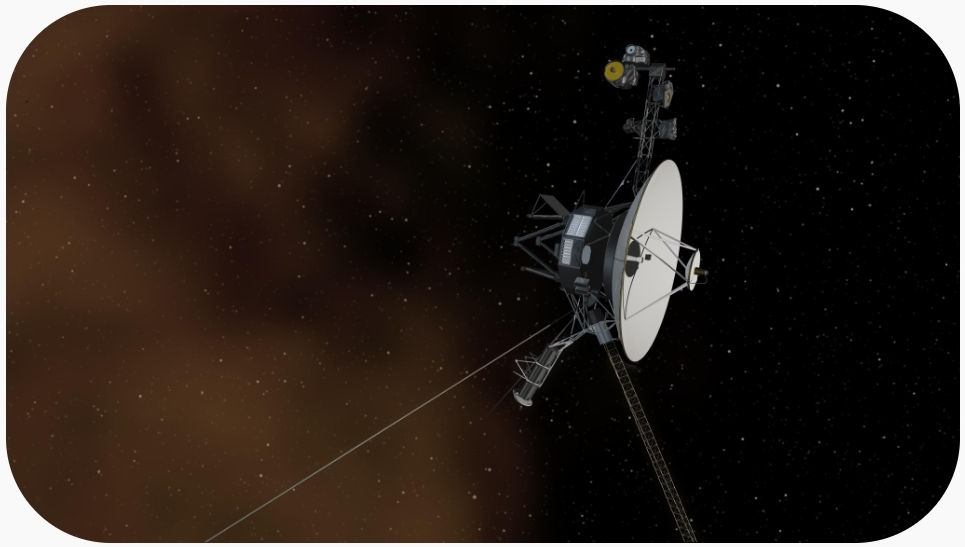
Voyager 1 will be 16.09 billion miles from Earth on Nov. 18, one light-day away, NASA said on Oct. 29. A radio command sent that day takes 24 hours to arrive, and the reply takes 24 hours to come back. The probe gets there after a month that tested it. Its signal went missing for two scheduled contacts on Oct. 18 and 19, and engineers had already swapped out three devices in September to stretch a power supply that shrinks every year. The mission now runs on a power budget, and the engineers are trading hardware to keep science instruments switched on.
What Happened During the October Communications Pause
NASA’s Deep Space Network could not detect a signal from Voyager 1 during two scheduled contact attempts 24 hours apart on Oct. 18 and 19. The signal returned on Oct. 20, and contact has held since. Engineers found that one group of thrusters had gone offline and the backups had switched on. The switch is automatic under fault protection, which puts the spacecraft into a safe configuration and pauses normal operations so engineers can diagnose a problem. The investigation into the cause is continuing.
Kareem Badaruddin, Voyager mission manager at NASA’s Jet Propulsion Laboratory, said it was the first time the spacecraft had done this. He said the mission is at a point where the team “has to expect the unexpected” and that the team was relieved to be back in contact.
How Engineers Cut Voyager 1’s Power Use
In early September, engineers turned off three Voyager 1 devices and replaced them with three lower-power alternatives. They finished about six weeks after the same swap on Voyager 2. The six devices help keep the spacecraft warm, so the three changes had to happen at once to keep heat distributed properly.
The swap lets the remaining science instruments run longer than expected. Without it, engineers would likely have had to shut off another instrument as early as summer 2027. Voyager’s power comes from radioisotope thermoelectric generators, which convert heat from decaying plutonium into electricity. Each Voyager loses about 4 watts a year. The mission launched in 1977 with 10 dedicated science instruments, and some were turned off after the planetary encounters. Two more have been turned off in recent years. The instruments still running study the outer region of the heliosphere and interstellar space.
What One Light-Day Means for Mission Control
Voyager 1 travels at about 38,000 mph, which covers roughly 912,000 miles a day, a calculation from NASA’s speed. On Nov. 18 the distance will reach 25.89 billion kilometers, the metric version of the 16.09 billion miles NASA gave. Suzanne Dodd, Voyager project manager at the Jet Propulsion Laboratory, described sending a message and then having to “wait two days before you finally get a response.” NASA said the spacecraft will not detect any environmental change at that distance and nothing aboard will change. The milestone marks the scale of the universe and the length of the mission. Voyager 1 crosses the one light-day mark on Nov. 18.