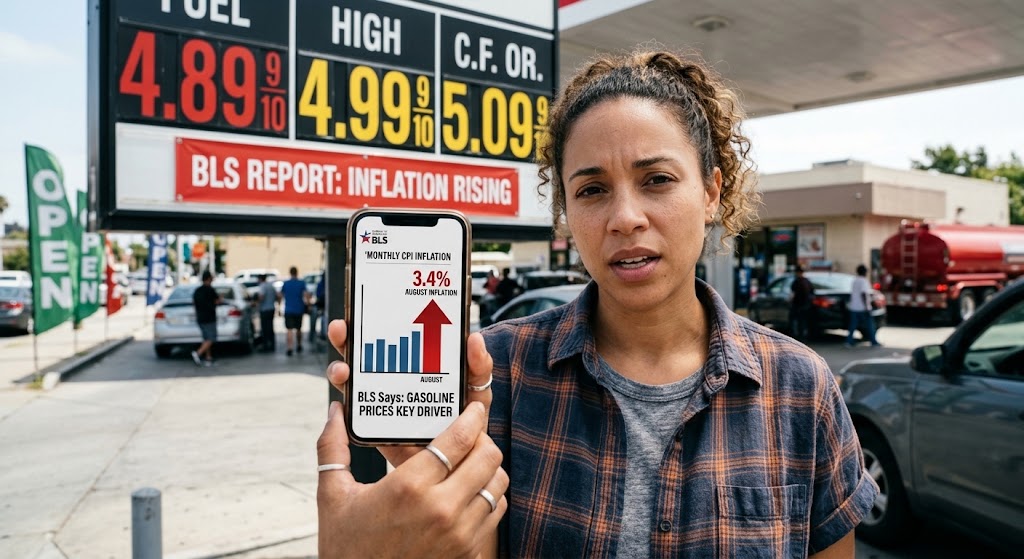
Consumer prices rose 3.4% over the 12 months ending in August, driven largely by a sharp jump in gasoline and fuel oil costs, the Bureau of Labor Statistics reported Sept. 11. The report shows an economy where energy costs are climbing far faster than wages, rent or the overall price index, adding fresh pressure on household budgets heading into fall.
What Happened
The Consumer Price Index for All Urban Consumers rose 0.4% in August on a seasonally adjusted basis and 3.4% over the previous 12 months on an unadjusted basis, according to the Bureau of Labor Statistics. Core CPI, which excludes volatile food and energy prices, rose a more modest 0.3% for the month and 2.4% over the year.
Energy prices were the dominant driver. The BLS energy index jumped 2.1% in August alone and is up 16.3% over the past year. Gasoline rose 3.9% for the month — “accounting for over one third of the monthly all items increase,” according to the bureau — and is up 27.4% year-over-year. Fuel oil rose even faster, climbing 10.1% in August and 52% over the past 12 months.
What We Know
Not every category moved the same direction. Shelter, the largest single component of the CPI, rose a comparatively modest 0.3% for the month and 3% over the year — elevated by historical standards but not accelerating the way energy costs are. Food prices rose just 0.1% in August and 2.7% over the year. Airline fares jumped 2.7% for the month and are up 23.4% over the past year, while medical care costs actually fell 0.2% in August and motor vehicle insurance fell 0.8%. Lettuce prices, a volatile item tied to growing conditions, dropped 6.2% in August after a 16.4% drop in July.
The pattern is unusual for this stage of an economic cycle: an energy-driven price shock arriving even as separate government data show a resilient job market. The Labor Department’s August jobs report, released Sept. 4, showed payrolls grew by 162,000 with unemployment holding steady at 4.1%, stronger than many economists had forecast.
Why Gasoline Jumped So Much
A 27.4% year-over-year increase in gasoline prices is large enough that it alone reshapes the entire inflation picture: the Bureau of Labor Statistics said gasoline accounted for more than a third of August’s total monthly price increase across every category the agency tracks, from groceries to rent to health care. Fuel oil’s 52% jump over the same period compounds the effect for the smaller share of households, disproportionately in the Northeast, that still heat with oil rather than gas or electricity.
Because energy costs feed into the price of nearly everything else — shipping, manufacturing, agriculture — economists watch a spike like this one for early signs it will show up in core inflation figures in the following months, even though core CPI held at a comparatively tame 2.4% in August.
Why It Matters
Gasoline and fuel oil increases hit household budgets immediately and visibly, in a way that shows up at every fill-up rather than in a monthly bill. A 27.4% year-over-year gasoline increase compounds a stretch of already-elevated shelter costs, meaning many households are absorbing higher costs on two of their largest monthly expenses simultaneously.
The report also lands at a politically charged moment for the Federal Reserve. New Fed Chair Kevin Warsh, who took over from Jerome Powell in May, warned at the Jackson Hole Economic Policy Symposium on Aug. 28 that inflation was “running above our 2% target,” citing a personal consumption expenditures inflation reading of 3.7% over 12 months. “We must be confident that underlying inflation is moving to our objective, clearly and at sufficient speed,” Warsh said. “Otherwise, we have work to do.”
Economists are split on how the Fed should respond. Dan North, senior economist at Allianz Trade, said inflation has made no meaningful progress toward the Fed’s target: “Without an interest rate hike, you’re going to have a hard time reaching that” goal, he said. Jay Hatfield, chief investment officer at Infrastructure Capital Advisors, argued the opposite, saying “we think it would be ill-advised to raise rates at this juncture,” and suggesting government inflation estimates may overstate the true pace of price increases.
President Donald Trump, who nominated Warsh, has publicly pushed for lower rates rather than higher ones. “I have a lot of respect for him and he’ll do what he has to do,” Trump said of Warsh in late August, adding, “I think our interest rates are too high.” He has separately argued that “lower interest rates because the U.S.A. is a much stronger credit than it was just a short time ago” and warned that high rates put “the U.S.A. at a very unfair disadvantage.”
What Happens Next
The Federal Reserve’s rate-setting committee was scheduled to announce its next policy decision Sept. 16, with traders pricing in a high probability of a rate increase rather than a cut, according to Kiplinger’s tracking of futures markets as of Sept. 15 — an unusual outcome given Trump’s public pressure for lower rates, and one that would raise borrowing costs on mortgages, credit cards and auto loans at the same time gasoline and fuel oil prices are already squeezing household budgets. The next monthly CPI report, covering September, is due in mid-October.
Mortgage rates, which have hovered near 7% for much of the year, would likely climb further in the event of a Fed rate increase, adding another cost pressure for prospective homebuyers already contending with elevated home prices. Credit card and auto loan rates, both tied more directly to the Fed’s benchmark rate than mortgages are, would also be expected to rise relatively quickly following any hike, unlike shelter costs, which tend to adjust more slowly.