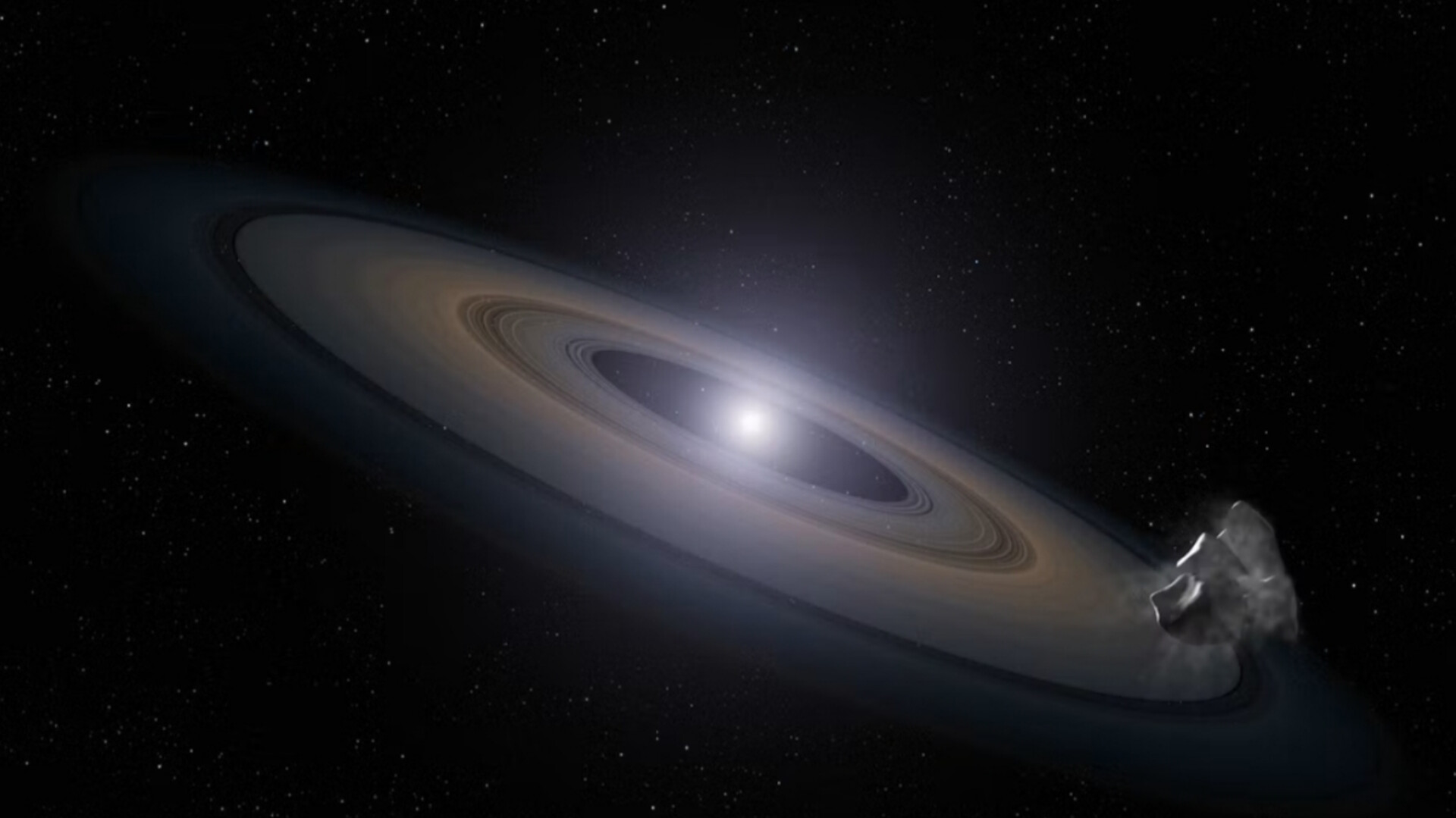
Astronomers reanalyzing Hubble Space Telescope data first collected in 1999 have found niobium in the atmosphere of a white dwarf, a chemical clue to a possible planet that formed after its star died. The team published the result Oct. 5 in Nature Astronomy.
What Hubble Recorded in 1999
The star is HS 0209+0832, a white dwarf, which is the remnant core of a low-mass star that has shed its outer layers. According to a Space Telescope Science Institute release, Hubble first observed it in 1999 and recorded about 100 spectral features that no one had identified. The release points to a 2000 paper in Astronomy & Astrophysics as the original “cold case.”
Jamie Williams, a doctoral candidate at the University of Warwick in England and the paper’s lead author, reanalyzed the archived spectrum with an updated chemical database. Many of the unidentified features matched niobium. Data from NASA’s retired Far Ultraviolet Spectroscopic Explorer, known as FUSE, also showed strong niobium signatures, the release said.
Boris Gaensicke, a co-author at Warwick, said he was astonished when Williams raised niobium in connection with the study. A calculation from the dates: the data waited 27 years between the first observation in 1999 and the paper in October 2026.
Why Niobium Points to a Second-Generation Planet
The paper, titled “Discovery of a second-generation planet candidate accreting onto a white dwarf,” reports an atmosphere unlike any body in the solar system. It is rich in zinc, copper and niobium and poor in silicon and iron. The authors detected nine metals and set upper limits on 15 others. They report niobium at more than three orders of magnitude above its abundance in the Sun, which means more than 1,000 times as much.
Nicholas Stone, a theoretical astrophysicist at the University of Wisconsin-Madison and a member of the team, said in the release why that matters. Elements heavier than iron are not made by fusion in the core of a normal star. They form in the brief, extreme conditions inside dying stars. Niobium in a white dwarf’s atmosphere therefore signals material that the star made and threw off late in its life.
The authors’ reading is that a giant planet formed from that ejected material. They call it a second-generation planet because it did not form with the star. They also point to what is missing from the atmosphere. Helium is present, and the rock-forming elements silicon and iron are scarce. The authors say that combination suggests the white dwarf is pulling gas from an evaporating giant planet.
The TESS Signal and the Planet’s Orbit
NASA’s Transiting Exoplanet Survey Satellite, known as TESS, observed the star for about four months, according to the release. The paper reports a repeating brightness change with a period of 4.399 days, plus or minus 0.026 day, and an amplitude of 0.120%, plus or minus 0.018 percentage point. The authors put the false-alarm probability near 4.4 in 10 quadrillion.
From that period and their models, the team places the candidate about 0.04 astronomical units from the star, or about 3.7 million miles, closer than Mercury is to the Sun. The release describes it as a gas giant about the size of Jupiter that is losing atmosphere. The paper says the 4.4-day signal could come from the planet’s day-night cycle or from a comet-like tail of evaporating gas. It also rules out a brown dwarf companion above about 20 Jupiter masses.
The paper gives rates for the gas being lost. It estimates evaporation of about 1.1 trillion grams a second for a planet of one Jupiter mass and about 14.3 trillion grams a second for 13 Jupiter masses. The white dwarf’s measured accretion rate is about 430 million grams a second. Divided, the evaporation estimates run about 2,600 times and about 33,000 times the accretion rate. Those ratios are a calculation from the paper‘s published rates. The authors attribute the gap to hydrogen, helium and metals that the spectra could not measure.
What the Authors Say is Unsettled
The paper calls the object a candidate and lists reasons for caution. The brightness signal is statistically significant only in TESS sectors 43 and 71. Sectors 42 and 70 show no clear detection, though the authors’ injection tests suggest a signal of this size could be present and still go unseen. Photometric scatter is about 2.1%, and TESS’s large pixels leave room for contamination from other light sources.
The cometary-tail explanation for the variability is not ruled out. The helium abundance varies by a factor of two to three over an unknown time period, and the spectra come from different epochs between 1999 and 2002. The authors write that detailed atmospheric modeling of second-generation planets is still needed.
They say the atmosphere code they used is not public and is available on request. The release uses cautious language as well, calling the planet “suspected.” It quotes no outside researcher disputing the finding.
What Comes Next
Williams plans several more years of Hubble observations to find out how these systems form, how common they are and how they change around dead stars. Williams said in the release that if the second-generation planet is there, “I think it is likely to survive.”
The release adds that once the white dwarf cools, the planet could hold a stable temperature for millions of years. The release says it is not yet known how common second-generation planets are. Gaensicke said the work shows that scientific discovery does not follow a straight path.