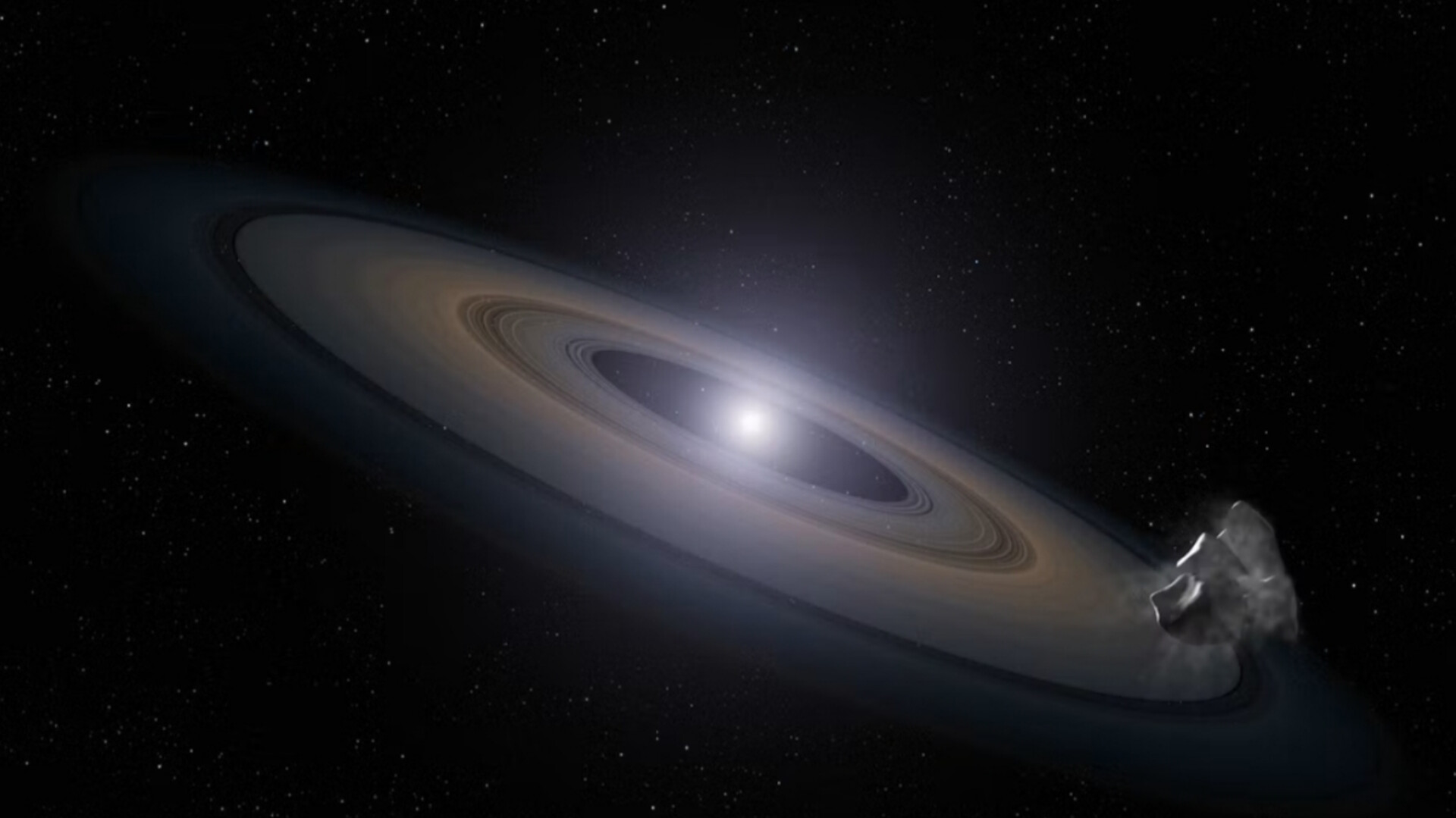
Astronomers at the University of Warwick have identified the first known green star, a white dwarf called WD J1330+6435 whose sodium-laden atmosphere would look chartreuse to a human eye. The same study names a salmon-pink white dwarf 48 light-years away as the reddest star known.
The University of Warwick announced the work on Oct. 15. The paper, titled “Any colour you like: The diverse chromaticities of white dwarfs,” appeared the same day in RAS Techniques and Instruments (DOI 10.1093/rasti/rzag069). The authors are Mark Hollands, Boris Gänsicke, Pier-Emmanuel Tremblay and Detlev Koester.
Why a Green Star Had Never been Found
Most stars shine in colors that track their surface temperature. A hot star looks blue, a cool one looks orange or red, and the Sun sits in between. The paper’s abstract says this works because the gas in an ordinary star’s atmosphere only slightly alters the overall color of its light, so these stars behave roughly like an ideal glowing body. Green falls between blue and red on that scale, and a star radiating a smooth spectrum at that temperature looks white to the eye, which blends all of the colors together. A pure green star therefore cannot come from temperature alone.
White dwarfs break the pattern. These are the dense cores left after a star like the Sun burns through its fuel. The paper says their atmospheres can be far denser than those of normal stars, and that heavy broadening of the absorption lines from metals and molecules can push their spectra far from the smooth glow of an ideal radiator. The coolest known white dwarf atmospheres reach a density of about 1 gram per cubic centimeter, which is close to the density of liquid water.
Hollands, a Warwick Prize Fellow in the university’s Astronomy and Astrophysics Group, led the study. In the release he said white dwarfs have produced surprises. “It turns out these incredibly dense stars can produce colours nobody expected, and some of them genuinely surprised me,” Hollands said.
How WD J1330+6435 Turns Green
The green star is WD J1330+6435. The release puts its temperature at about 4,000 degrees Celsius, which is cool for a white dwarf. Material from a destroyed planetary body has fallen into its atmosphere. The release lists sodium, calcium and lithium among the contaminants, and the paper counts roughly 2,000 white dwarfs known to carry this kind of planetary debris.
Sodium does the visual work. In the release, Hollands said the sodium absorbs the orange part of the spectrum. Removing orange from the light of a star that is otherwise yellow and red leaves a greenish glow. The team describes the result as chartreuse, a yellow-green.
The astronomers did not photograph the colors directly. The paper explains that the team integrated each star’s spectrum over the standard CIE 1931 color-matching functions, which model human color vision. They converted the result to the sRGB color space used by computer screens. That produces a color-accurate picture of what a person would see if the star were bright enough for the eye to register color. The pictures the university released are artist depictions and simulated color panels, with credits to Mark A. Garlick and Hollands.
The Reddest Star on Record
The second headline result is WD J1011+2845, also cataloged as LHS 2229. The paper gives its distance as 14.73 parsecs, with a margin of 0.01, and its temperature as about 4,300 kelvin. It has a deep salmon-pink color. The authors call it likely the reddest star known in perceived color.
The release puts the distance at about 48 light-years. The two figures agree. One parsec equals about 3.26 light-years, so 14.73 parsecs works out to about 48 light-years. That arithmetic is the writer’s own calculation from the paper’s distance, and it matches the release’s figure.
The pink comes from carbon. The release says carbon brought to the surface shifts most of the star’s light to wavelengths beyond 600 nanometers, which is the orange and red end of the spectrum. The paper treats a group of carbon-bearing white dwarfs, labeled DQ and DQpec, using 36 spectra from the Sloan Digital Sky Survey. It says the peculiar DQpec spectra appear below about 6,500 kelvin, where the helium-rich surface layers exceed about 0.15 grams per cubic centimeter in density.
Other stars in the paper fill out the palette. The authors describe two cyan white dwarfs, WD J0039+3035 and WD J1403+4533. They list an orange one, WD J0854+3503, and a vivid pink one, WD J1333+0016. They also describe a pale purple star, WD J0136+2004, and a peach one, WD J1803+2320. WD J1113+0146 is pink with strongly distorted molecular bands and a magnetic field.
How Common Unusual White Dwarf Colors are
The team also asked how often the odd colors turn up. In a volume-limited sample of 151 white dwarfs within 20 parsecs, about 65 light-years, five had unusual colors. Two were yellow and three were pink. Five out of 151 is about 3.3%, or roughly one in 30.
Gänsicke, a professor in Warwick’s Department of Physics, described the figure in the release. “One in thirty might not sound like a huge fraction,” Gänsicke said. The release goes on to say the team found that the average white dwarf really is white.
The paper backs that with a number. For the 20-parsec sample, the median correlated color temperature is about 6,800 kelvin, which the authors say establishes that, on average, white dwarfs are indeed white. For comparison, the paper gives the Sun’s correlated color temperature as about 5,870 kelvin. The typical white dwarf in the local sample is therefore slightly bluer-white than the Sun.
Neither the nearby sample nor the one green star settles how many green white dwarfs exist. The 151-star sample contained no green stars at all. WD J1330+6435 is a single object, and the release does not say how far away it is. The study calls it the first known green star, so its discovery does not predict a second.
What the Finding Adds to White Dwarf Research
Astronomers have long used the colors of white dwarfs to estimate temperature and age, because a white dwarf cools steadily for billions of years. The new paper shows that the same color can also reveal a star’s chemistry. A green or pink tint points to sodium, lithium or carbon in the atmosphere, and those elements often trace a destroyed planet or asteroid or the mixing of a star’s own interior.
Hollands said in the release that nobody had really looked into what else might be possible for white dwarfs. The paper’s method now gives astronomers a way to do it. Any white dwarf with a routine spectrum can be converted into a color-accurate rendering, and the authors note that spectral models can generate images of the white dwarf’s disc.
The peer-reviewed paper was received Aug. 11 and accepted Sept. 3 before it appeared on Oct. 15. The colors it reports come from existing spectra and published atmosphere models. A future spectrum of better quality could refine a color, such as the lower-signal-to-noise measurement the paper flags for WD J1251+4403, a visually blue star at 12,700 kelvin. The identification of the green and salmon-pink stars rests on the published analysis.