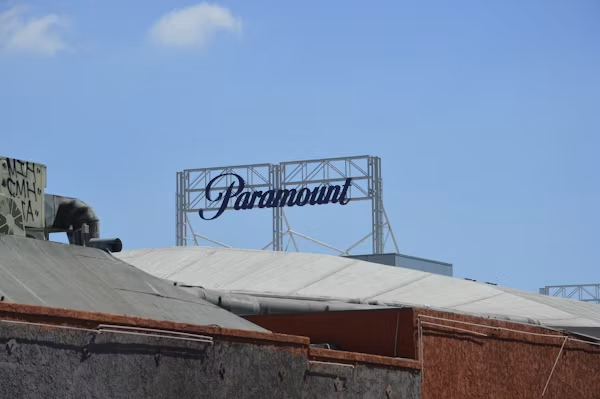
Paramount could be forced to sell BET, VH1 and Comedy Central under a conditional clause in the $110 billion Warner Bros. Discovery settlement it reached Sept. 21, 2026, though a sale would trigger only if Paramount breaches specific carriage and streaming commitments over the next five years.
Settlement Resolves 12-State Antitrust Challenge
California Attorney General Rob Bonta led a 12-state challenge to Paramount’s acquisition of Warner Bros. Discovery before the two sides reached a settlement that clears the way for the merger to proceed. Bonta said the agreement was not an endorsement of the deal itself. “This settlement is not a vote of support for this merger,” Bonta said, according to Axios, adding that it reflected “honest, good-faith negotiations.”
Paramount CEO David Ellison credited the states’ attorneys general and the Writers Guild of America for reaching terms with the company. “We are grateful to Attorney General Bonta and his fellow AGs, as well as the WGA, for engaging in good faith to find a path forward,” Ellison said, per the same Axios report.
The settlement requires Paramount to commit more than $300 million per year to domestic film production for five years, totaling $1.5 billion, and $9.5 million per year for five years toward television production workforce training. It also mandates a minimum of 30 theatrical releases per year, rising to 32.
Divestiture Clause Is a Compliance Penalty, Not a Sale Order
Reporting on Sept. 22, 2026 detailed a separate mechanism buried in the settlement that ties BET’s ownership to Paramount’s future conduct rather than requiring an immediate sale. The clause does not order Paramount to sell BET, VH1 or Comedy Central. It instead attaches divestiture as a potential penalty to two specific obligations Paramount must maintain for five years.
The first obligation requires Paramount to negotiate cable carriage deals for its own networks separately from Warner Bros. Discovery’s networks for five years, preventing the combined company from bundling carriage negotiations across both portfolios. The second requires Paramount to maintain Pluto TV, its free ad-supported streaming service, for five years.
If Paramount violates either commitment, the settlement allows for divestiture of BET, VH1 and Comedy Central. No breach of either condition has occurred as of Sept. 24, 2026. The mechanism functions as a standing enforcement tool attached to Paramount’s carriage and streaming behavior rather than a scheduled or pending transaction, and it leaves BET’s ownership status technically unresolved for as long as those five-year commitments run.
BET’s Valuation History Shows a Widening Gap Between Bidders
The settlement reopens a question Paramount had appeared to close. The company had more recently signaled BET was not for sale before the settlement’s conditional clause put a divestiture scenario back on the table, even if only as a contingency.
Paramount’s own past exploration of a BET sale tells a different valuation story than the offers it received from outside bidders. In 2024, Paramount explored a sale of BET in the $1.6 billion to
$1.7 billion range, with bidders including then-BET CEO Scott Mills and Chinh Chu of CC Capital. That figure sits roughly half the value of an earlier offer BET drew from media entrepreneur Byron Allen, who bid $3.5 billion for the network in a prior year. BET also drew separate interest from Tyler Perry and Sean Combs in earlier years, though neither reached the offer stage Allen’s bid did.
The gap between Allen’s $3.5 billion offer and the $1.6 billion to $1.7 billion range Paramount itself explored in 2024 points to a sharp divide in how insiders and outside bidders have valued the network over time. Outside bidders pursuing BET as a standalone, potentially Black-owned media asset priced it near $3.5 billion, while Paramount’s own sale process two years later valued the same network at roughly half that figure.
That divide reflects diverging assumptions about BET’s worth inside a struggling cable bundle versus its worth as an independent, culturally significant brand freed from Paramount’s broader portfolio.
Why BET’s Ownership Status Matters
BET remains the largest Black-audience-focused cable brand in the United States, though it is corporately owned by Paramount rather than independently Black-owned. That ownership structure has been a recurring flashpoint in debates over Black media ownership, fueling the interest from bidders like Allen, Perry and Combs who each explored acquiring the network in past years.
The settlement does not resolve that debate. It keeps the ownership question technically open rather than closed, tying any future change in BET’s ownership not to a fixed timeline or an active sale process but to whether Paramount complies with commitments that have nothing directly to do with BET’s day-to-day operations. BET’s fate over the next five years now depends on Paramount’s conduct in cable carriage negotiations and its maintenance of Pluto TV, two obligations that sit outside BET’s own programming or business performance.
What Happens Next
Divestiture of BET, VH1 and Comedy Central becomes possible only if Paramount breaches the settlement’s carriage-negotiation requirement or fails to maintain Pluto TV as a free service at any point over the next five years. Neither breach has occurred, and the settlement does not set a sale timeline or process absent such a violation. For now, the $110 billion merger with Warner Bros.
Discovery can proceed under the terms Bonta and the other 12 states’ attorneys general negotiated with Paramount. Whether BET’s ownership changes hands will depend on decisions Paramount makes about its carriage negotiations and streaming operations over the next five years, not on any sale process currently underway.