Amazon pledged $20 million on Sept. 21 as the anchor investment in a new coalition built to fund water conservation projects across the drought-stricken Colorado River Basin, aiming to help raise $100 million over two years for work spanning seven states.
Amazon’s $20 Million Anchors New River Basin Coalition
The retail and cloud computing company announced the commitment through a new initiative called the Colorado River Basin Collaborative, a partnership that also includes Aldi, The CocaCola Foundation, Ecolab, EdgeConneX, Grundfos, Vantage and Xylem. The Water Resilience Coalition, a program tied to Amazon’s Climate Pledge network of more than 700 companies, is administering the effort.
Rather than pooling money into a single shared fund, each participating company finances its own projects through independent contracts. Organizers say that structure lets dollars move faster, since a single company does not have to wait on group consensus before signing off on a project.
Kara Hurst, Amazon’s chief sustainability officer, framed the approach as an extension of lessons the company learned through its broader climate work. “Through the Climate Pledge, we’ve seen what happens when companies tackle a problem together: progress accelerates,” Hurst said.
The coalition has raised $32 million so far toward its $100 million, two-year goal, including Amazon’s contribution. That leaves the group less than a third of the way to its target, with roughly $68 million still to secure before the initiative’s 2028 close.
Two Funded Projects Reveal Which Approach Saves More Per Dollar
Amazon’s pledge funds a range of work, but two projects account for its currently detailed commitments, and together they offer a rare side-by-side comparison of which conservation strategy stretches a dollar further.
The first is a $2.2 million, three-year partnership with the Municipal Water District of Orange County in California to expand leak detection and pipe repairs across the utility’s distribution system. Amazon projects the work will save 189 million gallons a year once complete, according to its announcement.
The second is a $2.4 million investment in irrigation efficiency on tribal farmland in the Lower Colorado River Basin. The project pairs soil sensors powered by Amazon Web Services with real-time data on when and how much to irrigate, and it is projected to save 238 million gallons a year that would otherwise be drawn from Lake Mead.
Add the two together and the scale of the pledge becomes clearer: 189 million gallons plus 238 million gallons comes to 427 million gallons of water saved every year, funded by a combined $4.6 million between the two projects.
Divide each project’s cost by its projected savings and a gap opens between the two approaches. The Orange County leak-detection program costs about 1.16 cents for every gallon it saves each year, the result of dividing its $2.2 million budget by 189 million gallons. The tribal irrigation project costs about 1.01 cents per gallon, dividing its $2.4 million budget by 238 million gallons saved.
That makes the irrigation project roughly 13% cheaper per gallon saved than the leakdetection work. Flipped around, the irrigation project returns about 99 gallons of conserved water for every dollar spent, compared with about 86 gallons per dollar for the Orange County program.
Neither project is a poor use of money by conservation standards, and both draw on a similar advantage: they replace waste that was already happening, rather than asking users to consume less. But the arithmetic shows that upgrading irrigation technology on farmland delivered more water per dollar than fixing leaks in an urban pipe network, at least for these two projects as designed.
Colorado River Basin Faces a Deepening Drought
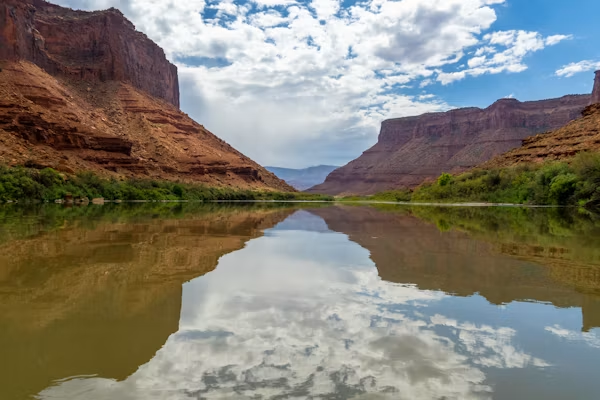
The Colorado River supplies drinking water and irrigation to about 40 million people across seven states and Mexico, according to Amazon’s announcement. It also waters 5.5 million acres of farmland and supports 30 tribal nations, and the basin’s farms produce roughly 90% of the winter vegetables consumed in the United States.
The river’s two largest reservoirs, Lake Mead and Lake Powell, have fallen below 30% of capacity after 25 years of drought across the basin. Amazon’s announcement puts the basin’s annual gap between water supply and demand at roughly 1 trillion gallons, a shortfall that has forced water managers in Arizona, California and Nevada into years of negotiations over mandatory cutbacks.
Federal money has not closed that gap. The Inflation Reduction Act set aside $4 billion for Colorado River conservation, but those funds were frozen in early 2025, according to KUER. A coalition of business groups from all seven basin states has since asked Congress for $2 billion in additional funding to replace it.
Corporate dollars are not new to the basin. The nonprofit Bonneville Environmental Foundation has channeled more than $27 million from major corporations into Colorado River conservation projects since 2020, according to KUER. Water policy experts note that corporate funding tends to work best when paired with public money rather than standing in for it, since companies fund discrete projects rather than the ongoing operations and infrastructure that public agencies maintain.
What Happens Next
Amazon says the Orange County and tribal irrigation projects are already vetted and ready to build, and work on both is set to begin immediately and run through 2028, the same year the coalition’s two-year fundraising window closes. The independent-contract structure means additional projects can start as soon as a coalition member signs off, without waiting for the broader $100 million target to be reached.
The Water Resilience Coalition says it will keep recruiting corporate partners to close the gap between the $32 million committed so far and the $100 million goal. Amazon has operated in Arizona since 2007 and has invested more than $40 billion in the state, a footprint that ties its own operations directly to the river’s long-term health.
For now, the two funded projects stand as the collaborative’s first test cases, and the tribal irrigation project has set the early benchmark other members will be measured against: nearly 100 gallons of water saved for every dollar spent, a mark future projects funded through the coalition will need to match or beat if the group hopes to turn $32 million into real progress on a trillion-gallon shortfall.