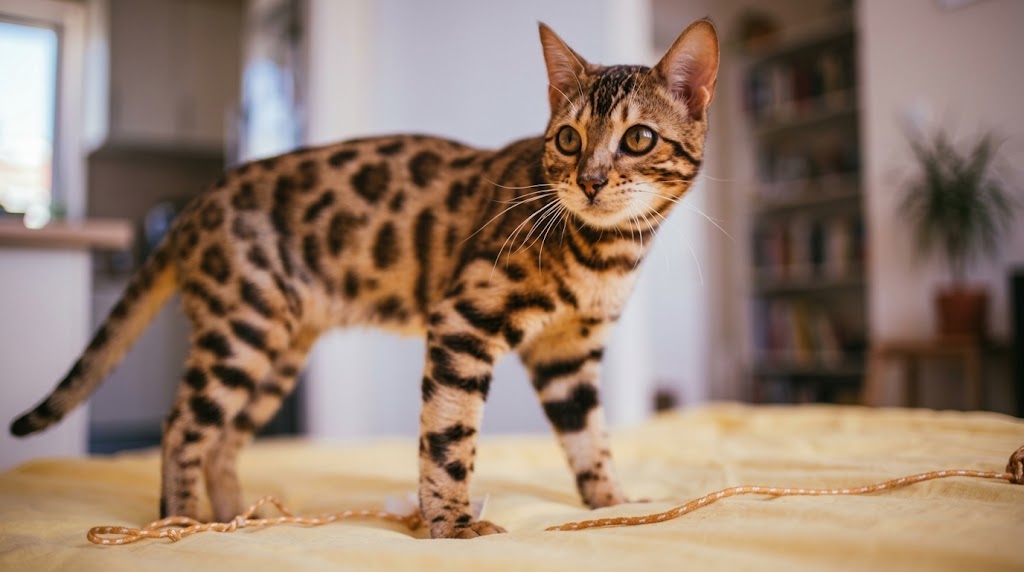
Scientists have formally described Leopardus tilcayo, a small leopard-spotted wild cat from Bolivia’s Yungas forest, making it the first new felid species named since the pampas cat in 1923. Biologist Paola Nogales-Ascarrunz led the study, published Sept. 17, 2026, in Current Biology.
How a Kitten Found on a Forest Road Became a New Cat Species
The animal at the center of the discovery has lived for years in plain sight. A local man found it as a kitten wandering a forest road in Bolivia’s Yungas region, the subtropical belt on the eastern slope of the Andes that sits between lowland rainforest and high mountain peaks. He assumed it was a stray domestic cat and kept it for about a year before its wild behavior convinced him otherwise. He then brought it to Senda Verde Animal Refuge, a wildlife sanctuary, where Nogales-Ascarrunz first encountered it in 2017.
At the time, she classified it as a northern tiger cat, Leopardus tigrinus, one of several small spotted cats that range across Central and South America. Two years later, while preparing a species identification booklet, she noticed the animal did not quite match. Its face looked more scrunched than a typical tiger cat’s. Its ears were shorter and rounder, its whiskers longer, and its rosette spots noticeably larger and bolder than those of its closest relatives, National Geographic reported. The male cat, now 10 years old, still lives at the refuge. He is about 18 inches long and weighs 3 pounds, smaller than an average house cat.
“I took a hundred pictures of it,” Nogales-Ascarrunz said. “I was so fascinated.” That fascination launched a research effort that would take years of genetic work to confirm what she suspected: the animal at Senda Verde belonged to a species science had never named.
Long Before Science Had a Name, So Did the Yungas
The scientific paper gave the cat a name that was not invented in a lab. Researchers called it tilcayo, the term Yungas residents had already been using for generations. When NogalesAscarrunz’s team asked local people where the word came from, the answer was consistent and unremarkable to them: their grandparents used it, so they used it too. The word does not translate cleanly into Spanish or Quechua. It simply belongs to the place.
That detail reframes what “discovery” means in this case. Wai-Ming Wong of the wild cat conservation group Panthera, who was not involved in the study, put it plainly. “This isn’t an animal that nobody had ever seen before,” Wong said. “Local communities knew it existed, but until now science had not recognized it as a separate species.”
Formal taxonomy tends to arrive after informal knowledge, not before it, and this case makes the gap unusually visible. It also underscores how rarely that gap gets closed for mammals as visible and as studied as cats. The last time researchers named a new wild felid species was 1923, when the pampas cat was described. More than a century passed before Leopardus tilcayo joined the list. Nogales-Ascarrunz said the finding is a reminder of how much remains unclassified even in a well-documented animal family. “Our world is extremely complex,” she said. “Sometimes we think that most of it is known, that there’s not a whole lot to discover, but in fact, it’s the other way around.”
What DNA From 38 Cats Revealed
Confirming a new species required more than a closer look at ear shape and spot pattern. Nogales-Ascarrunz worked with geneticist Eduardo Eizirik of the Pontifical Catholic University of Rio Grande do Sul in Brazil and Jonas Lescroart of the University of Antwerp to compare genomes from 38 individuals across the Leopardus genus, the group of small spotted cats native to the Americas. The Current Biology study, titled “Phylogenomics and museomics reveal five distinct species of tiger cats in South America,” found that the tilcayo lineage split off from other tiger cat relatives roughly 1.4 million years ago, an evolutionary distance the researchers compared to the split between modern lions and the extinct cave lion.
That analysis did more than add one new name to the cat family tree. It restructured the whole branch. What field guides had long treated as a single, wide-ranging species, the northern tiger cat, turned out to be five genetically distinct species spread across South America. Eizirik described the shift in how scientists now think about animals once assumed to be uniform across huge ranges. “What we once thought to be a single species, we’ve started to see that it was actually a species complex,” he said.
The reclassification carries real weight for conservation, not just taxonomy. A single species stretching from southern Brazil to Costa Rica can look secure on paper simply because its total range is enormous. Split into five narrower species, each with a smaller population and territory, and the calculus changes. Eizirik has noted that researchers will now need to assess each of the five tiger cat species separately rather than relying on one broad, and potentially misleading, population estimate.
The same genomic approach hints at a similar situation in margays, another small spotted cat long assumed to be a single species across Mexico, Central America and South America; early data suggests that population may in fact represent four distinct species.
What Happens Next
Basic facts about Leopardus tilcayo in the wild remain unknown. Researchers have not documented what it eats, what preys on it, how it reproduces, or how many exist outside the one specimen studied closely at Senda Verde. Fieldwork in the Yungas, an ecoregion already under pressure from agriculture and logging along the Andes’ eastern slope, will need to establish a population count before conservation status can be assigned with any confidence.
The discovery also points toward a broader shift in how small cats get studied worldwide. The genomic techniques that separated tilcayo from its tiger cat relatives are increasingly affordable and available to research teams outside major institutions, which raises the odds that other small, under-studied cat populations in Africa and Asia could turn out to be distinct species once someone runs the same comparison.
For now, the tilcayo’s formal recognition stands as a rare event in mammalogy, a confirmation of what people in one corner of Bolivia already knew, delivered through more than a century of taxonomic silence on new cats.