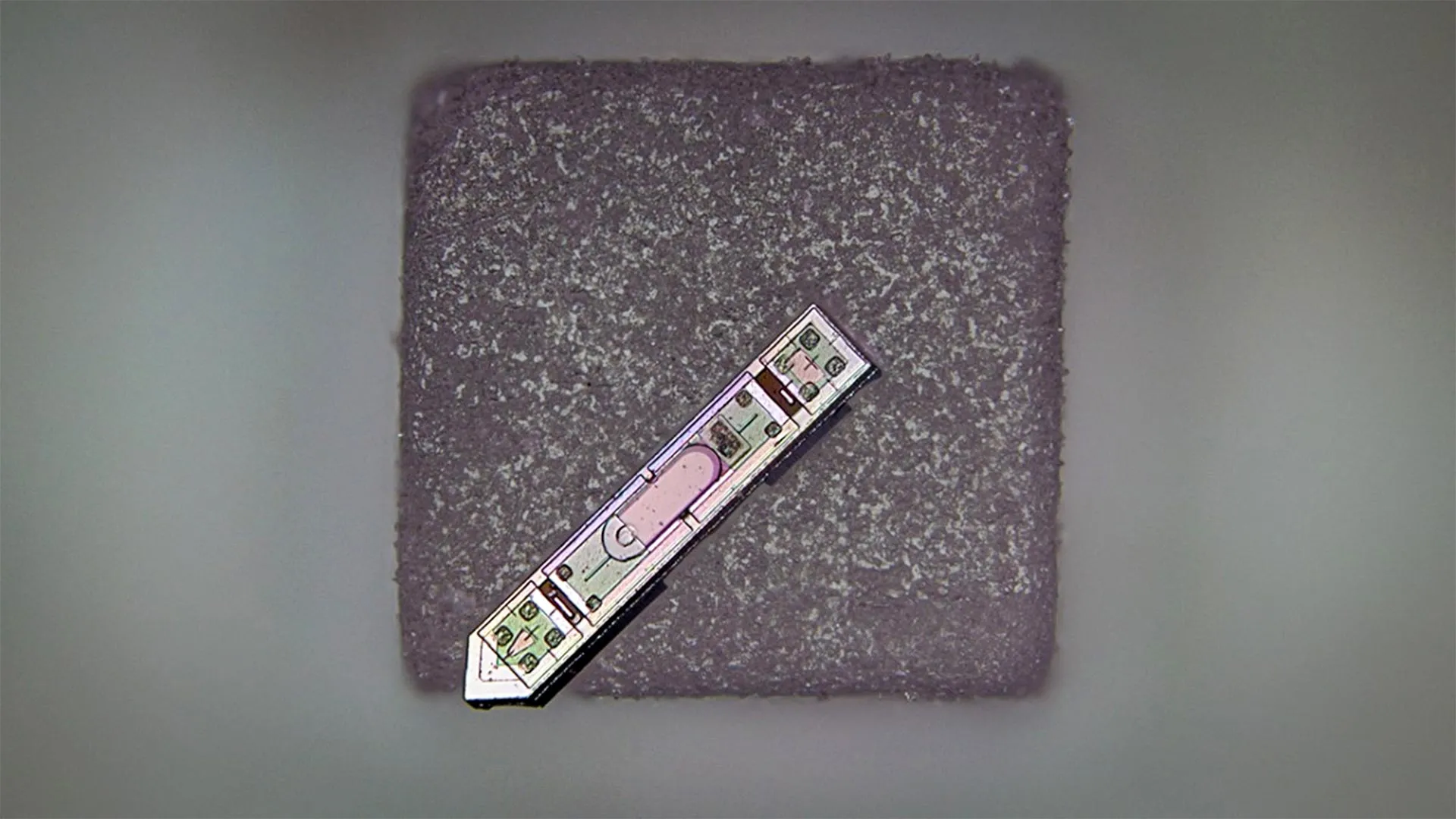
Cornell University researchers have built a wireless brain-recording device smaller than a U.S. dime that lets mice run, forage and socialize outdoors while scientists watch their neurons fire in real time, according to a study published Sept. 10 in Nature Methods. The device, called WILD, is the first tool to combine lab-grade neural recording with full freedom of movement in a natural setting.
WILD, short for Wireless, Interactive, Lightweight Datalogger, was designed to solve a decadesold problem in neuroscience: lab recording equipment is typically wired to a rig, forcing animals to stay tethered or confined to small enclosures that bear little resemblance to how they actually live. The device weighs less than a dime, is shaped roughly like a tiny chef’s hat and uses flexible probes that can track the same groups of neurons for months at a time, according to Cornell Chronicle.
Its modular components let researchers swap in different sensors depending on what they want to measure, and its housing is built to withstand outdoor humidity and moisture, conditions that would damage most lab-grade recording equipment.
Cornell researchers tested WILD on mice over a two-week outdoor deployment, mapping more than 1,600 place cells, the neurons that fire when an animal is in a specific location, as the mice explored a naturalistic environment. The device also recorded more than 3,000 ultrasonic vocalizations between mice and tracked pupil dilation, giving researchers a window into the animals’ internal states as they foraged and interacted with one another.
WILD can also perform closed-loop optogenetic stimulation, triggering light-based control of specific neurons within 5.56 microseconds of a detected brain signal, fast enough to intervene in real time as an animal’s brain activity unfolds. The device can also deliver electrical stimulation directly, giving researchers two separate ways to manipulate brain activity in an animal that is running, digging or interacting with other mice rather than sitting in a lab enclosure.
The study’s most striking finding may be that tethered mice behave differently than mice wearing WILD.
Place cells recorded in freely roaming, untethered animals showed patterns that differed from those recorded in the wired setups used in decades of prior neuroscience research. That prior body of work includes the discovery of place cells itself: neuroscientist John O’Keefe won a share of the 2014 Nobel Prize in Physiology or Medicine for identifying the cells in the 1970s, and May-Britt Moser and Edvard Moser shared the same prize for later discovering the related grid cells that help the brain form cognitive maps.
Cornell researchers said the finding raises questions about how much of the last half-century of neuroscience data reflects an animal’s natural brain activity versus behavior shaped by the tethered recording apparatus itself.
Cornell has released WILD’s design files, code and datasets as open source under a GPL-3.0 license on GitHub, allowing other labs to build and modify the device without licensing fees or proprietary restrictions. “Before you could either record neural activity with high resolution in the lab or you could record behavior in nature. Now we can do both,” Oliva said, according to Cornell Chronicle. “If we do it that way, the entire field moves forward,” she said of the decision to release the device’s design publicly rather than commercialize it.
The Nature Methods study was led by Zifang Zhao, a research associate in the Oliva-FernandezRuiz lab, with co-authors Hongyu Chang, Praveen Paudel, Jaehyo Park, Can Liu and Cornell undergraduate Maria Aurelio. The team’s initial field experiments took place in enclosures north of Cornell’s Ithaca campus, where researchers recorded place cells activating as mice navigated the outdoor terrain, the first such recordings ever captured outside a lab setting.
Funding and the Researchers Behind It
The study’s co-senior authors, Azahara Oliva and Antonio Fernandez-Ruiz, run Cornell’s Brain Computation and Behavior Lab in the Department of Neurobiology and Behavior. The lab studies how animals produce adaptive behavior, using electrophysiology, optogenetics, imaging and computational modeling to trace how neurons, circuits and whole-brain systems support learning, memory and decision-making as conditions change.
The WILD project builds on that broader research agenda by giving the lab a tool to study those same questions outside the constraints of a laboratory rig.
The research drew support from the National Institutes of Health along with a cluster of private foundations, including the Whitehall Foundation, the David and Lucile Packard Foundation, the Alfred P. Sloan Foundation, the Simons Foundation, the Pershing Square Foundation, the Pew Charitable Trusts and the Mong Family Foundation.
The team benchmarked WILD’s recording quality against the Intan RHD2000, a widely used commercial recording platform for tethered lab setups, to confirm the wireless device did not sacrifice signal fidelity for portability.
How the Device Classifies Behavior on Its Own
WILD’s onboard computer runs compact machine-learning models, a technique known as TinyML, that classify social behaviors such as sniffing, chasing, fighting and tail rattling directly on the device as they happen, according to a technical breakdown of the study. That lets the device trigger optogenetic stimulation based on an animal’s actual, observed behavior rather than a researcher’s manual judgment call made after the fact. A separate onboard system uses a gravity-constrained model built from the device’s inertial measurement unit to predict an animal’s locomotion speed, acceleration and head angular velocity in real time, giving researchers continuous behavioral data to pair with the neural recordings.
Cornell researchers said future work with WILD will extend beyond mice to study social coordination, seasonal changes in brain activity, neurodivergence and the long-term effects of psychedelic compounds on brain tissue. “Our technology enables precisely these kinds of novel experiments that were not possible with existing approaches,” Fernandez-Ruiz said.
Collaborators outside Cornell have already begun adapting the device for use in birds, bats and monkeys, extending the same untethered recording approach to species and settings where wired equipment has never been practical.